
DD, or due diligence, examines an acquisition target in detail. It is not complete merely because experts receive accounts and contracts and deliver a thick report.
The point is deciding whether to buy on these terms. If an issue emerges, should price change, the contract protect against it, it be resolved before closing, or the acquisition be abandoned?DD's value lies not in the number of findings but in changing transaction decisions and execution.
Not buying can be a valuable result even after spending money
In an independent hypothetical, JPY3 million has already been spent on DD for a JPY300 million share purchase when continuation of a major customer contract cannot be confirmed. Losing it would substantially reduce expected profit.
Compare making renewal a closing condition, revising price, and abandoning the deal. A desire to recover the JPY3 million already spent cannot justify committing another JPY300 million.
Diligence has value not only in listing issues, but in changing purchase conditions or deciding not to buy. Signing merely because the process has gone this far fails to use the findings.
First tell advisers what you intend to acquire
Priorities differ with acquisition purpose, even for the same target. For customers, check contract continuity. For technology, verify ownership and likely retention of the people using it. For earnings, test whether they recur.
Requesting only generic DD from lawyers, CPAs, or tax accountants can misalign scope with the buyer's business assumptions. Share the purpose, price assumptions, and what would be especially damaging to lose at the outset.
| What the acquisition should deliver | Starting point for review | Examples of additional decision-relevant information |
|---|---|---|
| Recurring earnings | Monthly results and customer or product profitability | One-off revenue, omitted necessary costs, and recent lost business |
| Customer relationships | Major contracts, sales mix, and renewal dates | Change-of-control clauses, renewal prospects, and termination reasons |
| Technology and content | Rights registers and development or production agreements | Ownership and dependence on contractors or individuals |
| People and organization | Organization chart, responsibilities, and employment records | Critical roles, compensation concerns, and successors |
| Factories and stores | Asset registers, leases, and repair history | Replacement investment, continued-use conditions, and permits |
These are examples, not a requirement to investigate every field equally in every deal. Add IT, employment, environmental, or other specialist reviews according to industry and size. Clearly identifying unreviewed areas is as important as reporting findings.
Distinguish causes when figures differ
Suppose some receivables remain unpaid past their due dates. Do not immediately label them uncollectible. Review invoices, delivery and acceptance, correspondence, and later receipts to distinguish timing delays, commercial disputes, and collectibility issues.
An unrecoverable asset is also different from reduced future earnings. A single historical receivable differs from broader problems in revenue recognition or customer management, with different valuation and operational effects.
Omitted recurring maintenance costs require revising future earnings. A specific historical loss may instead fit an asset or liability adjustment. Automatically reducing both earnings and assets for the same issue can double-count a price reduction.
Ask reviewers not only whether there is an error but which period, figure, and amount it affects. Separate verified facts from estimated ranges where amounts remain uncertain. Missing documents are themselves important evidence of an inability to verify.
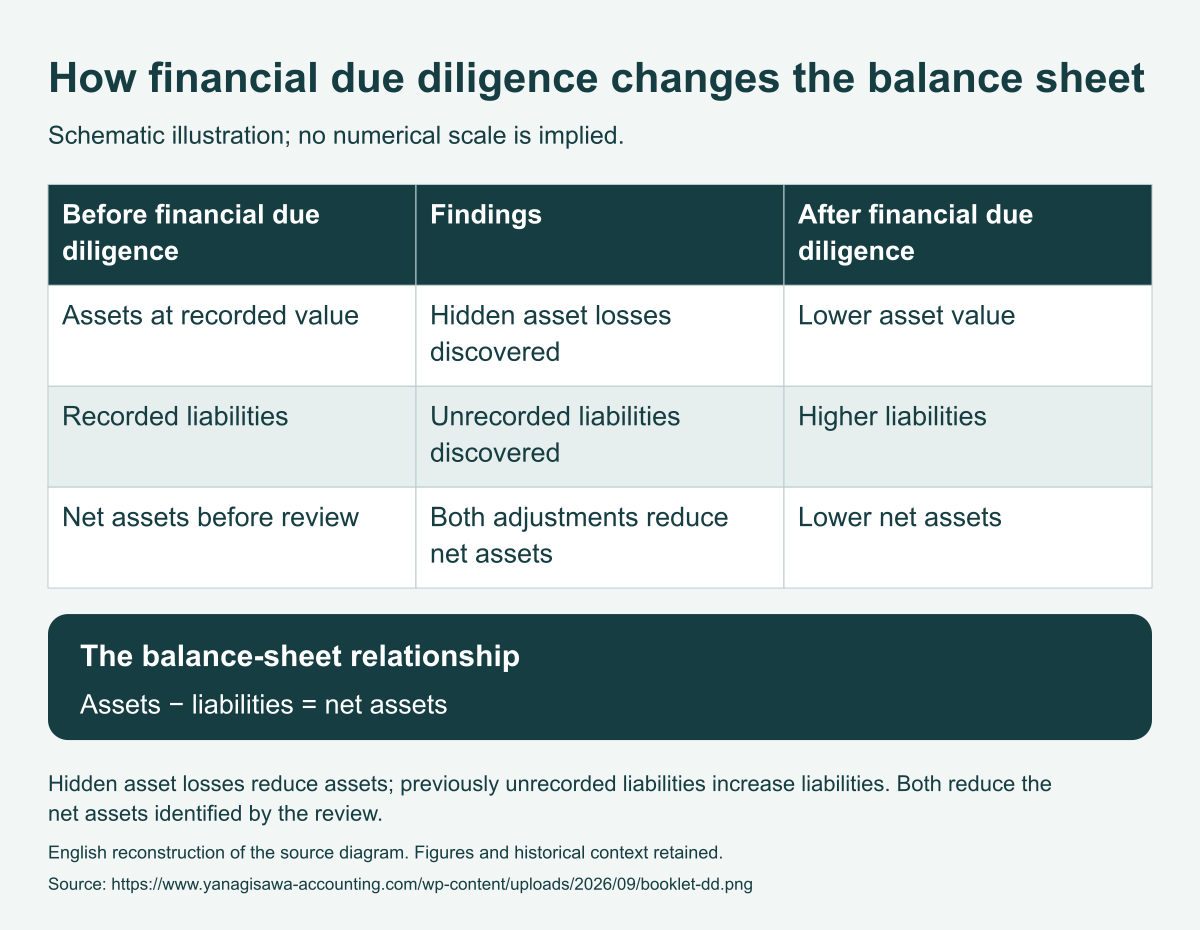
Kenji Yanagisawa, 10 Checkpoints for Successful M&A: A Guide to Peace of Mind Diagram excerpted from p.19.
The diagram shows how revaluing recorded assets and adding unrecorded liabilities reduces net assets. However, the net-asset adjustment does not necessarily equal the purchase-price adjustment. Return to the valuation method and agreed price mechanism.
Translate findings into price, contract, and execution decisions
Organizing DD findings by response helps negotiation. Actual responses may overlap; this table does not automatically determine treatment.
| Issue found | Main response | Decision required |
|---|---|---|
| Recurring earnings or asset-value assumptions differ | Reconsider price | How to reflect it in valuation and price adjustments |
| A specific historical risk remains | Contractual allocation of liability | Scope, duration, cap, claim procedure, and enforceability in practice |
| Material consent or procedure incomplete | Pre-closing action | Who completes it by when, and what happens if incomplete? |
| The acquisition purpose is undermined | Consider renegotiation or cancellation | Can revised terms work, or must the decision be reconsidered? |
| Operational issues to fix after acquisition | PMI implementation plan | Owner, budget, deadline, and improvement metrics |
A contractual indemnity does not solve everything. Separately assess claim conditions, the counterparty's ability to pay, and whether money can compensate for business interruption or customer loss. Financial reviewers and lawyers must share the issue.
Sellers also impede progress if they treat every finding as a pretext for cutting price. Distinguish supported findings from unverified concerns and provide contrary evidence where available. For fixable issues, specify cost and timing so the buyer can assess terms.
End the report with unresolved matters
Separate expert reports can still leave material transaction issues unresolved. A legal contract concern and a financial revenue risk may actually concern the same customer.
Appoint a buyer-side person responsible for consolidating findings. For each issue, maintain one list of verified facts, evidence, unknowns, financial or business impact, response, owner, and deadline. Decision-makers should see this list and how findings affect price and contract.
Hand post-closing issues to the PMI team. If billing controls need repair, who checks next month's invoices? If key customers need explanations, who is the contact? Transfer actual work rather than ending with “improvement required” in a report. The SME Agency's practical PMI tools also move from current-state analysis to priority issues, responsible people, and planned actions.
DD cannot foresee every future problem. It can record what was checked, what remained unverified, and what decision was made in that state. Its role is improving judgment whether the acquisition proceeds or stops.
This manuscript is a general explanation based on laws and regulations as of September 9, 2026. Please obtain advice on your individual circumstances before taking action.
We take care in preparing this information. If you notice an error, please let us know through our contact page.
If You Would Like Advice on Your Own Circumstances
See our support and consultation process for company sales, acquisitions, and business succession.
M&A Intermediation ServicesSee services, fees, and how to apply.