
Hearing that someone “sold a company for JPY100 million” may suggest that JPY100 million entered the owner's bank account. But whether shares or the business were sold changes both who receives the money and how it is taxed.
In M&A, compare not just the price but who retains how much after tax. The preferred sale structure also depends on whether the money will fund personal life or the company's next business investment.
Shareholders sell shares; companies sell businesses
Consider a Japanese-resident individual owning 100% of a domestic unlisted company. Comparing a third-party share sale with a sale of the business by the company itself, the initial cash flows are as follows.
| Sale method | What the buyer acquires | Initial recipient of the price | Person initially taxed on the gain |
|---|---|---|---|
| Share sale | Shares held by the shareholder | The individual shareholder | Individual |
| Business sale | Business assets and other items held by the company | The selling company | The company |
Buyer → Individual shareholder
Tax on the individual's gain → Individual cash remaining
Buyer → Selling company
Tax on the company's gain → Company cash remaining
Separately consider dividends, retirement payments, or other transfers to the individual
A share sale does not replace the company itself. Its shareholders change, but the legal entity operating the business remains the same. In a business sale, the contract identifies what transfers. Contracts, employment, permits, and debts each require their own procedures. These transactions cannot freely be substituted on identical terms based solely on tax rates.
| Things to confirm | Share sale | Business sale |
|---|---|---|
| Scope of sale | Company shares; the business and assets remain inside the same corporation | Selected business, assets, liabilities, and other items |
| Customer and supplier contracts | The contracting party remains unchanged; check clauses requiring consent or notice for changes in controlling shareholders | Check counterparty consents and procedures needed to transfer contractual positions |
| Employment contracts | The corporate employer remains the same | Individual employees' consent is required for succession |
| Permits and licenses | The holder remains the same; check notifications and requirements for changes in officers or control | Not necessarily transferred automatically; check succession or reapplication under each industry law |
| Loans and past liabilities | Remain with the same company; the buyer acquires shares in the company bearing them | Check assumed liabilities and creditor consent; beware exceptions creating responsibility even for liabilities intended to be excluded |
| Selling owner's personal guarantees | A shareholder change alone does not release them | A business sale alone does not release them |
For employment contracts in business transfers, the Ministry of Health, Labour and Welfare's guidance on reorganizations and business transfers requires employees' genuine consent. For permit checks, see Specific Measures in the SME PMI Guidelines.
It is also risky to assume a business buyer can eliminate all historical liability simply by buying only desired assets. Check liability when continuing the trade name and the method of assuming debt under both the contract and Article 22 and related provisions of the Companies Act. Since a share acquisition takes over the company, investigating even off-balance-sheet liabilities through due diligence is particularly important.
Compare a JPY100 million sale in one table
The following is anindependent hypothetical exampleto explain the mechanism, not a recreation of an actual deal or a tax estimate.
Assume an individual founded a company with JPY10 million of capital, and it holds only business assets with a JPY10 million tax basis, with no debt or surplus cash. Compare selling all shares for JPY100 million with the company selling its business for JPY100 million. Share acquisition cost and business asset tax basis are set equal solely for illustration.
Assume a 2026 transaction, no effects from other personal income or special provisions, and corporate tax of 30% of profit to simplify the calculation.The corporate 30% is not a uniform statutory rate. Fees, consumption tax, liquidation costs, and similar items are also excluded.
| Calculation stages | Individual sells shares | Company sells business |
|---|---|---|
| Sale proceeds | 100 million yen | 100 million yen |
| Acquisition cost or book value deducted for tax | 10 million yen | 10 million yen |
| Gain on sale | JPY90 million | JPY90 million |
| Tax rate used in this example | 20.315% | 30% (assumed) |
| Tax on the gain | JPY18,283,500 | JPY27 million |
| Cash after tax | JPY81,716,500 to the individual | JPY73 million to the company |
| Cash received by the individual at that point | JPY81,716,500 | 0 yen |
The zero on the right does not mean the owner's wealth disappeared. The owner still holds shares in a company with JPY73 million cash. However, company money cannot simply be spent on personal living expenses.
The JPY10 million acquisition cost on the left is capital paid in the past. It is deducted in calculating the gain but is not paid again from sale proceeds, so it is not deducted twice in calculating current cash remaining.
In practice, the buyer's post-acquisition taxes and assumed liabilities and risks also affect price. The same JPY100 million is used on both sides to illustrate taxation stages;it does not assume that shares and a business necessarily command identical market prices.
An individual's share sale is taxed on gain, not gross proceeds
Ordinary share sales are taxed on proceeds less acquisition cost and selling commissions and related costs. The basic 2026 rate is 20.315%: 15% income tax, 0.315% Special Income Tax for Reconstruction, and 5% resident tax. NTA: Taxation of Share and Similar Asset Sales
Verify acquisition cost through formation contributions, subsequent capital increases, and purchases from other shareholders. The company's recorded net assets and the individual's share acquisition cost are different figures. NTA: Acquisition Cost of Shares Sold
Exceptionally high income is subject to an additional minimum-tax measure. The 2026 reform changes its special deduction from JPY330 million to JPY165 million and its rate from 22.5% to 30% for 2027 onward. This does not mean all share gains are taxed at 30%, nor is 30% simply added to 20.315%. The additional amount is determined by comparing a prescribed calculation with ordinary income tax. Assess the sale year and other income together. Ministry of Finance: 2026 Tax Reform
Transferring company funds to the individual creates another tax question
Cash remaining after a business sale can fund the company's next venture. If it is transferred to the individual, model the method of transfer as well.
Dividends from an unlisted company to an individual shareholder are generally subject to aggregate taxation with other income. They do not end with the same 20.315% rate as share gains. Dividend credits and other factors mean the result depends on the person's income. NTA: Receiving Dividends
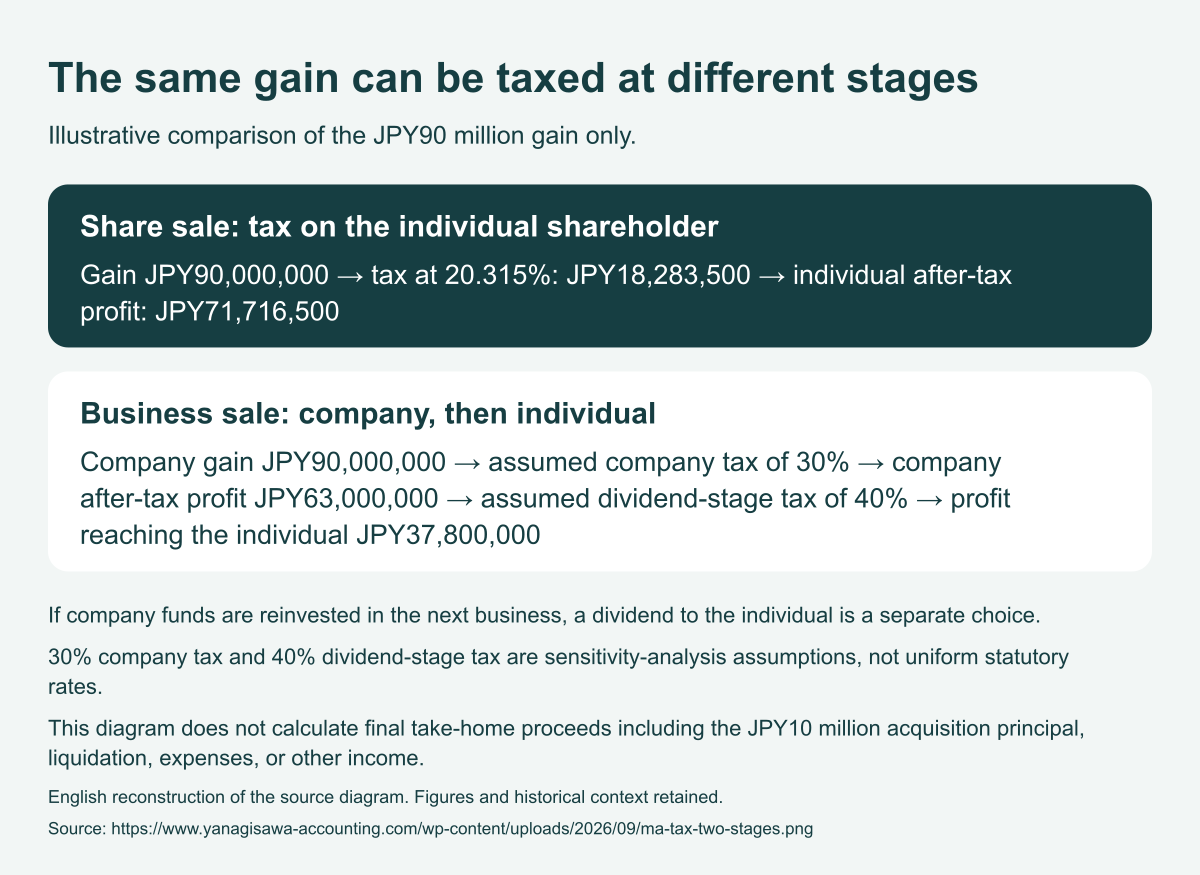
To see how the two tax layers combine, isolateonly the JPY90 million gainfrom the earlier example. Assume 30% corporate tax and lawful distribution of all JPY63 million remaining profit. This sensitivity analysis assumes the additional personal tax equals 30%, 40%, or 50% of that dividend. These are illustrative assumptions, not actual applicable rates.
| Assumed additional tax burden on dividends | Corporate profit after tax | Tax at dividend stage | Amount of profit reaching the individual |
|---|---|---|---|
| 30% | JPY63 million | JPY18.9 million | JPY44.1 million |
| 40% | JPY63 million | JPY25.2 million | JPY37.8 million |
| 50% | JPY63 million | JPY31.5 million | JPY31.5 million |
For comparison, applying 20.315% to a JPY90 million share-sale gain leaves JPY71,716,500 of after-tax gain. The table compares only profit, excluding the original JPY10 million remaining in the company, liquidation, or capital repayments. Assumed dividend taxes cannot establish an actual individual's final net proceeds.
The point is not to add corporate and personal rates mechanically, but to understand thattransferring after-tax corporate profit to an individual may create another layer of tax.
Retirement payments to a departing owner-manager may also be considered, but sale proceeds cannot simply be relabeled “retirement pay.” The company's deduction requires checking reasonable amounts and other conditions; the recipient's service period and actual retirement also matter. Certain payments to officers and similar persons with service of 5 years or less do not qualify for the usual half-inclusion treatment. NTA: Timing of Deductions for Officer Retirement Payments and Specified Officer Retirement Payments
A retirement payment also reduces company cash. Compare it together with its effect on the share sale price.
Consumption tax and what the buyer inherits also differ
Share transfers are exempt from consumption tax. Business transfers require separating taxable assets such as buildings and equipment from exempt assets such as land. Check whether the contractual total includes tax and how the price is allocated. NTA: Exempt Transactions and Sales of Business Fixed Assets and Similar Property
For buyers, acquiring shares and directly acquiring business assets can produce different subsequent tax calculations. This is one reason a seller-favorable structure may not attract the same price. Separately calculate personal net proceeds, company cash remaining, and the buyer's total cost to identify negotiable terms.
In a JPY176 million business transfer, the company receives the proceeds
On May 1, 2024, Smaregi acquired RIGUA's Rece ONE Plus software business for osteopathic clinics.The disclosed acquisition price was JPY176 million, paid in cash. The acquired business involved software development, maintenance, and sales, not all shares of RIGUA. Smaregi's Financial Results for the Fiscal Year Ended April 2024, supplementary materials, p.12
Here, the seller was RIGUA, the company holding the business. Business proceeds received by the company differ from money received by its individual shareholders. The disclosed price alone does not establish the seller's taxable income or shareholders' net proceeds.
In actual transactions, first identifythe contractual seller, what is sold, and who receives payment. This allows corporate and individual shareholder taxation to be considered separately.
Column: A sale changes how money and time can be used
Brochure "Safe and Sound! 10 Checkpoints for a Successful M&A"'s “The Transformative Power of M&A” and “M&A and What Comes After” broadened the focus from price to the owner's subsequent life. This perspective becomes clearer after tax.
For example, suppose an owner able to save JPY4 million annually after taxes and living costs receives JPY80 million after tax from a sale. Simple division equates this to 20 years of savings. This separate hypothetical excludes investment returns, inflation, and the time value of money.
Having upfront what would otherwise take 20 years to accumulate expands options for another startup, family time, and changing work patterns. However, selling also relinquishes future dividends and equity appreciation. Keeping the company may allow much greater growth.
This division therefore does not prove selling is better. It begins a comparison of selling and retaining ownership over consistent periods, after tax, and with future uncertainty considered. Investing sale proceeds also entails investment-loss risk.
Finally, calculate the money freely available to use
A net-proceeds schedule should go beyond price less tax, following this sequence.
- Identify whether the price is enterprise value or equity value. Adjustments are explained in our valuation article.
- Determine the individual's consideration from each shareholder's rights and stake sold.
- Separate fixed consideration from future additional payments contingent on performance or other conditions.
- Include costs, taxes, and payment timing to identify cash shortfalls.
- Reserve funds for indemnities and similar obligations, living expenses, and the next business.
Contingent consideration or installment receipts do not necessarily defer tax timing in the same way. Examine when rights become fixed under the contract. For continuing liabilities after sale, see our article on representations, warranties, indemnities, and personal guarantees will handle.
The value of involving a tax adviser early in M&A is drawing this complete after-tax picture before choosing the structure. What supports the owner's next life is not the large number in the contract, but usable money after conditions are checked and taxes funded.
This manuscript is a general explanation based on laws and regulations as of September 9, 2026. Please obtain advice on your individual circumstances before taking action.
We take care in preparing this information. If you notice an error, please let us know through our contact page.
If You Would Like Advice on Your Own Circumstances
See our support and consultation process for company sales, acquisitions, and business succession.
M&A Intermediation ServicesSee services, fees, and how to apply.