
Tax audit support
With Professional Support

We handle audits for our ongoing clients and one-off tax audit engagements for those without a regular tax advisor.
The tax office has contacted you, and you do not know what to prepare or how to explain your position. You may also disagree with points already raised. You do not have to handle this alone. Our principal and tax accountant, Kenji Yanagisawa, will review the facts and documents and help plan a response.
A Tax Audit Requires Clear Communication of Facts and Supporting Grounds
Does the tax auditor's explanation reflect the actual transaction? Are there differences in understanding the facts underlying the findings? Responding without fully understanding specialist issues can prevent you from presenting relevant circumstances and grounds.
We review the transaction history, agreements, accounting records, and related documents to identify the issues. We explain well-founded arguments properly and candidly identify points needing reconsideration. On that basis, we seek a resolution the taxpayer can accept.
Prepare for a tax audit before it arrives.
For ongoing clients, we review supporting evidence and the basis for decisions during everyday accounting and tax return preparation. Building on the working methods learned at KPMG Tax Corporation, our principal and tax accountant, Kenji Yanagisawa, performs the final review of returns.
Responding to audits is part of taking responsibility for the work we have performed. We therefore charge ongoing clients lower attendance fees than for one-off engagements.
Domestic Tax Advisory Services →You Can Engage Us Solely for a Tax Audit without an Ongoing Advisory Agreement
For standalone support, you provide a tax representation authorization form. Depending on the agreed scope, we attend the audit, review documents, and explain and negotiate matters with the tax office. If the audit is already underway, please first tell us its current status.
- Understand the Situation: We confirm the audit schedule, taxes and years covered, findings raised, and involvement of your current tax accountant.
- Organize documents and issues: Using the available materials, we identify facts to explain and issues requiring further analysis.
- Agree on the Scope and Fees: We explain the scope and fees before you formally engage us for audit support.
- Proceed with Audit Support and Discussions: We explain the position with supporting grounds and proceed while keeping the taxpayer informed of the response strategy for each finding.
Tax Audit Issues We Have Handled
We have provided individual engagements for both domestic tax audits and international tax audits, including resident versus nonresident status.
Domestic Tax Issues
- Eligibility as Tax-Qualified Stock Options
- Executive Bonuses
- Donations
- Employee versus Independent Contractor Classification
- Distinguishing Gifts from Compensation
International Tax Issues
- Resident or nonresident status
- Source of Income and Withholding Income Tax
- Determining Permanent Establishment (PE) Status
- Transfer Pricing Rules
Example:Non-residentdispute concerning tax-qualified stock options
Non-residentWe handled a one-off engagement concerning whether the stock options qualified for favorable tax treatment, with potential tax liabilities of several hundred million yen.
Our office presented counterarguments and explanations during the tax audit, and the case was ultimately settled with additional tax of several hundred thousand yen. This was resolved at the audit stage, before litigation.
Only a general outline is provided to respect confidentiality. These are individual case results and do not guarantee similar outcomes.
Where necessary, we consider a request for review or work with lawyers experienced in tax litigation. Disputing the matter is not an end in itself: we weigh the possibility of resolution at the audit stage against the burden of proceeding further.
The essence of tax analysis is the “legal syllogism”: connecting facts with law
A tax audit should not be decided by who speaks loudest or pushes hardest. What are the facts, and which laws apply to them, in what way? Verifying these points one by one is fundamental to tax practice.
The major premise is the legal requirement, the minor premise is the established facts, and the legal conclusion follows from them. This reasoning is calledLegal Reasoning. In practice, we move between fact verification and legal analysis, organizing the work as follows.
- Establishing the Facts: Verify what actually happened using evidence such as contracts, accounting records, transfer records, and emails.
- Interpretation of the Law: Determine the circumstances in which the relevant legislation imposes tax.
- Applying the law and reaching a conclusion: Apply the established facts to the legal requirements to determine the tax treatment.
That is why the starting point,Establishing the Facts and Supporting Evidenceis important. Can you demonstrate the actual circumstances at the time through documents, rather than simply say, “That was our intention”? Different findings of fact may lead to different conclusions under the same law.
Past facts cannot be changed to suit a preferred outcome. We develop explanations based on evidence and law without distorting the facts. Applying the law to reach a conclusion is distinct from a tax office taking an administrative action such as a reassessment or determination.
File an amended return, or challenge an assessment?
If our review shows that the original return was incorrect and understated tax, an amended return should be filed. If you disagree with the tax office's findings, however, it is necessary to examine their basis and carefully decide whether to amend.
An Amended Return Itself Cannot Be Administratively Appealed.
An amended return is filed by the taxpayer and is not a decision by the tax office. Do not assume you can simply file an amended return now and appeal that return later.
This does not mean all remedies disappear after filing an amended return. If the reported tax was excessive, a request for correction may be possible subject to the applicable requirements and deadlines. This is separate from an administrative appeal against the amended return itself.
Reference:National Tax Agency: “When an Administrative Appeal Is and Is Not Available”
If you do not amend and the tax office still considers tax payable, it may issue a reassessment or determination. If you disagree with that disposition, you can seek cancellation or modification through procedures such as a request for review by the National Tax Tribunal.
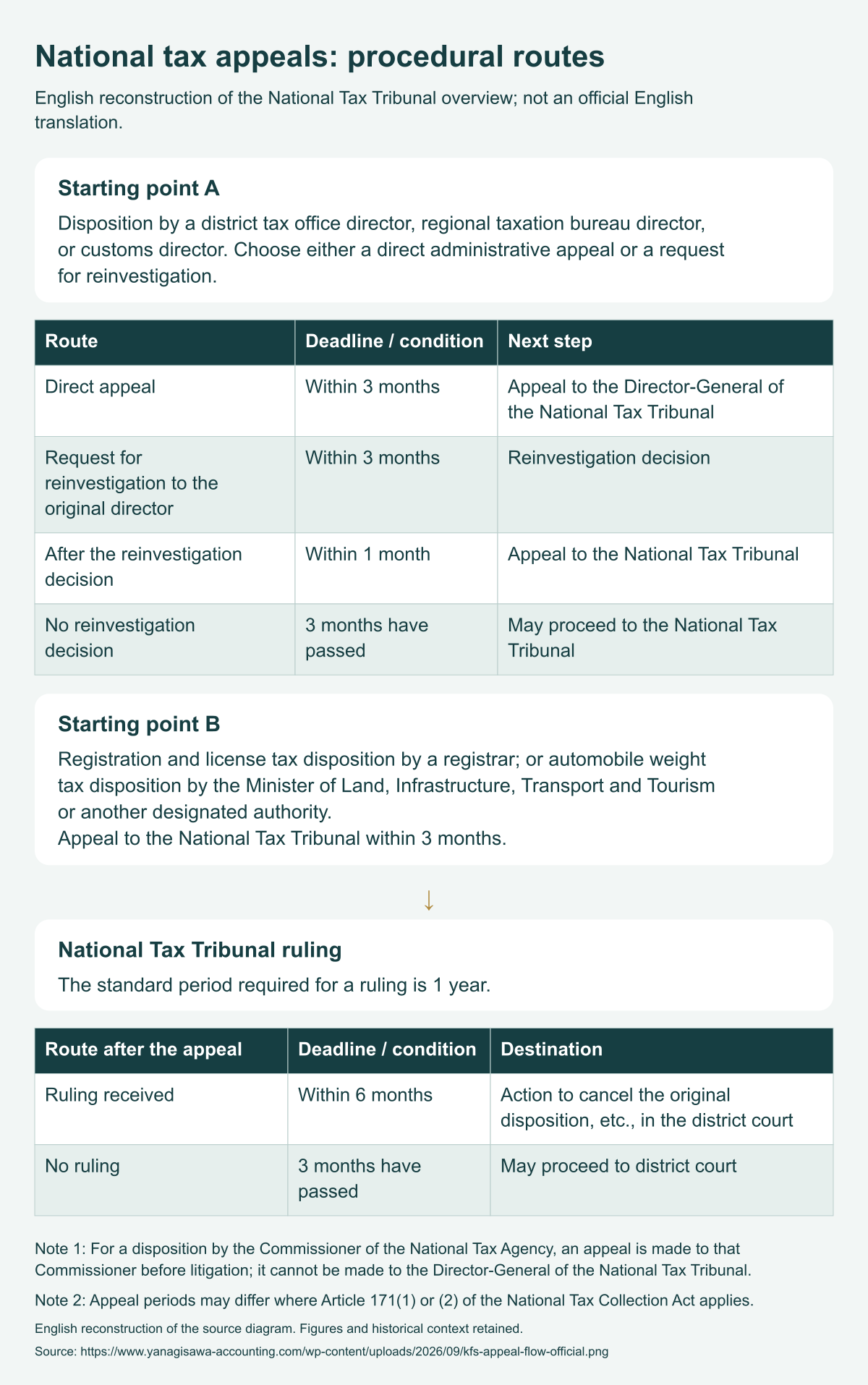
From Tax Audit to the Courts
Tax audit → Tax assessment → Request for review by the National Tax Tribunal → Tribunal decision → District Court → High Court → Supreme Court
The above adds our explanation of the process. There is also the option of requesting reinvestigation, and exceptions in certain circumstances allowing litigation before a review decision. If you remain dissatisfied with the assessment after a review decision, an action must generally be brought within six months from the day after learning of that decision. Appeals to higher courts have their own requirements and deadlines, and not every case proceeds to the Supreme Court. Cases may become final at district or high court level.
Reference:National Tax Tribunal: Appeal Procedures
From the audit stage, we consider what would be needed if the matter later becomes a dispute. We gather evidence and clarify where the disagreements lie in the facts and the law. Our audit support draws on experience with administrative reviews and tax litigation. If litigation becomes necessary, we work with lawyers experienced in tax disputes.
Our involvement in tax litigation
See also these court cases in which our firm provided tax support and assistance.
- Takefuji gift tax case: Supreme Court judgment in favor of the taxpayer (2011) →
After the High Court judgment, we provided the taxpayer with advice and research papers on nonresident status and domicile. - Nonresident status following relocation to Singapore: Partial taxpayer victory in Tokyo District Court, now final (2023) →
Lawyers acted as litigation counsel, while our office assisted as a tax accounting adviser.
Tax Audit Support Fees
| Initial consultation on your specific circumstances | JPY 55,000 per hour Online or In Person Where consumption tax applies, it is included in the displayed price. Where export exemption applies, the full displayed amount is the consultation fee. Your total payment remains the same in either case. |
|---|---|
| One-Off Tax Audit Support | Individual quotation on an hourly or success-fee basis |
| Indicative Success Fee | From 10% of the economic benefit (reduction in additional tax assessed) Excluding consumption tax |
| Tax Audit Attendance for Ongoing Clients | JPY 30,000 per half day (JPY 33,000 including tax) |
For individual engagements, time is needed to review documents and understand past transactions and returns. The work includes preparation and discussions with the tax office, not only attendance on the audit day, so fees can be substantial depending on the case.
Hourly rates, the work covered, and the calculation basis and scope of success fees are clarified in advance in the individual agreement. Existing advisory clients are also advised separately if work beyond audit attendance is required.
If an audit date has been set, please tell us the date. We will confirm whether we can assist based on the schedule and circumstances.
Choose How You Would Like to Consult Us.
Consult Directly with Kenji Yanagisawa, Principal and Certified Tax Accountant
For a direct 60-minute consultation with our principal, tax accountant Kenji Yanagisawa, without a preliminary email inquiry, book here. The fee is JPY 55,000 for either an online or in-person consultation.
Where consumption tax applies, it is included in the displayed price. Where export exemption applies, the full displayed amount is the consultation fee. Your total payment remains the same in either case.
You will proceed to the card payment screen. After your application, we will arrange the consultation date, time, and format.
Start with an Email Inquiry
Email inquiries are free. Tell us about the issue you are facing or what you would like to discuss. We will review your inquiry and recommend a paid consultation if you need specific tax judgments or advice.
There is no charge for submitting an inquiry. Please also use this form if you prefer to pay by bank transfer.
Tax audit attendance and representation require a separate engagement. If a date has been set, please tell us; we will assess availability after reviewing the schedule and circumstances.