
Our office is one of the relatively few Japanese tax accounting firms specializing in both international taxation and M&A.
Among the many matters we have handled, one particularly memorable case involved an owner-manager's relocation to Malaysia and an M&A transaction. We describe it below as a case study.
We hope it is useful to SME owner-managers interested in M&A or moving abroad.

The Consultation
At the end of 2012, an owner-manager called us. “If I remain a director in Japan and receive JPY50 million in remuneration, the maximum 50% tax burden would be JPY25 million. If I move overseas and run the business from there, wouldn't I pay only 20% withholding income tax, or JPY10 million? That would save JPY15 million. I also wanted my children to receive an English-language education, so I'd like to move abroad with my family and continue running the company.”
Analysis
• Director Remuneration of a Nonresident
A fundamental international tax principle is that Japanese residents are taxed on worldwide income, whether earned in Japan or abroad, while nonresidents are taxed only on Japanese-source income.
Residents' income is classified into ten categories, while nonresidents' income is broadly divided into twelve. Nonresidents also fall into four taxation patterns depending on their permanent establishment, or PE. The relationship between these twelve income types and four PE categories is summarized in the following NTA circular.
Income Tax Basic Circular 164-1
An overview of nonresident taxation is shown in Table 5.
Note that this table summarizes statutory treatment, and tax treaties may provide otherwise. (Amended by 1988 Chokuho 6-7 and Chokusho 3-8; 1990 Chokuho 6-5 and Chokusho 3-6; 1992 Kaho 8-5 and Kasho 4-3; 1996 Kaho 8-2 and Kasho 4-5; 1999 Kaho 8-1 and Kasho 4-3; 2001 Kaho 8-2 and Kako 2-7; 2002 Kaho 8-5, Kako 2-7, and Kashin 3-142; 2003 Kaho 8-3, Kako 2-13, and Kashin 3-19; 2004 Kaho 8-3; 2005 Kaho 8-2, Kako 2-19, and Kashin 4-89; 2007 Kaho 9-9, Kako 2-20, and Kashin 4-32; 2009 Kaho 9-3, Kako 2-17, and Kashin 4-31; 2010 Kako 2-16, Kaho 9-1, and Kashin 4-30; 2011 Kako 2-33, Kaho 9-9, and Kashin 4-46.)Table 5: Overview of Nonresident Taxation
Notes
1. Under Article 37-10 of the Act on Special Measures Concerning Taxation, gains from transfers of shares and similar assets by persons with a PE in Japan are subject to separate taxation by self-assessment at 15%.
Under former Article 37-11 before the 2008 amendment, a reduced 7% rate applies to gains on listed shares and similar assets transferred between January 1, 2003 and December 31, 2008. A reduced 7% rate also applies to such gains from January 1, 2009 through December 31, 2013 under Article 43 of the Supplementary Provisions of the 2008 amending Act.
2. Under Article 41-9 of the Act on Special Measures Concerning Taxation, prizes and similar benefits on prize-linked deposits are subject to separate withholding taxation at 15%.
3. Under Article 41-12, redemption gains on discount bonds, excluding certain specified short-term bonds and similar instruments, are subject to separate withholding taxation at 18%, or 16% for certain instruments.
4. Of income from assets, disposal gains are taxable only for real estate and the assets listed in Article 291, Paragraph 1, Items (i) through (vi) of the Enforcement Order.
5. Under Article 37-12 of the Act on Special Measures Concerning Taxation, gains from transfers of shares and similar assets by persons without a PE in Japan are subject to separate taxation by self-assessment at 15%.
6. Under Article 42, consideration received by certain tax-exempt entertainment corporations and similar entities is subject to a 15% rate.
7. Under Articles 3 and 41-10, interest and similar income (Item 4 income) and benefits on installment deposits and similar income (Item 11 income) received by persons with a PE in Japan are subject to separate withholding taxation at 15%.
8. Under Article 8-2, dividends and similar income (Item 5 income) received by persons with a PE in Japan that relate to distributions from privately placed bond investment trusts and similar trusts are subject to separate withholding taxation at 15%.
9. Under former Article 9-3 before the 2008 amendment, reduced rates apply to dividends on listed shares and similar assets, distributions from publicly offered securities investment trusts excluding bond investment trusts and specified stock investment trusts, and distributions on units of specified investment corporations. Dividends received by individuals holding at least 3% of the issuing domestic corporation's shares or capital on the relevant record date, or at least 5% for dividends payable before October 1, 2011, are excluded. The rate is 10% from April 1 through December 31, 2003 and 7% from January 1, 2004 through December 31, 2008. From January 1, 2009, Article 9-3 provides a 15% rate.
However, for the above dividends and distributions received between January 1, 2009 and December 31, 2013, a reduced 7% rate applies under Article 33 of the Supplementary Provisions of the 2008 amending Act.
10. Under Article 8-5, dividends and similar income received by persons with a PE in Japan, excluding those subject to separate withholding taxation, may qualify for the no-return election, under which they need not be included in aggregate taxation or separate self-assessed taxation, the latter from 2009 onward.
11. Under Article 9-6, profit distributions from foreign specified purpose trusts and income distributions from foreign specified investment trusts are deemed dividends of surplus received from domestic corporations.
12. Under Articles 5, 6-2, 6-3, and 7 of the Act, trustees of corporate taxable trusts are taxed on income attributable to the trust property as domestic or foreign corporations according to whether the entrusted business office is in Japan or abroad.
13. Under Article 41-21 of the Act on Special Measures Concerning Taxation, foreign partners under investment partnership agreements who have a PE in Japan for the partnership business and meet certain requirements are deemed not to have a Japanese PE upon submitting a return electing the special treatment.Source: Income Tax Basic Circular: Article 164, Methods of Taxation of Nonresidents
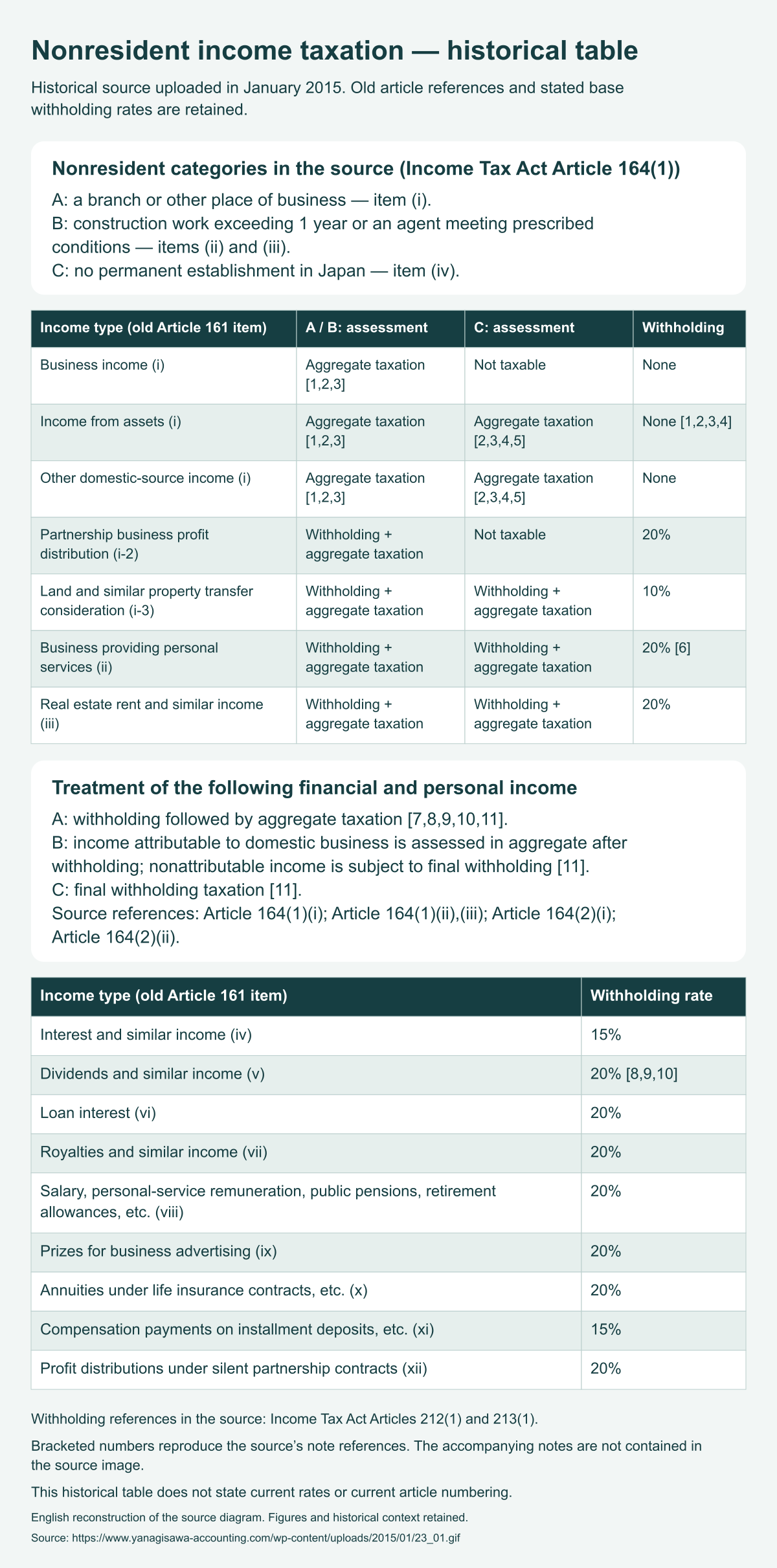
As shown above, nonresident director remuneration falls into the eighth of the twelve income categories, commonly called Article 161, Item 8 income. A director with no PE falls into the so-called fourth PE category. Without considering overriding treaty provisions, remuneration earned by a nonresident director in Japan is generally subject to final withholding tax at 20%, as the client suggested, potentially producing substantial tax benefits.
• Taxation in Malaysia
If a Malaysian resident remotely manages a Japanese company and receives director remuneration from it—in substance, managing from Malaysia and earning remuneration from Japan—how is this taxed in Malaysia?
Malaysia's income tax (corporation tax) rate is 22.5%, so it is not treated as a tax haven from Japan's perspective. Yet, like Singapore and Hong Kong, whose rates are 20% or less and which are treated as tax havens from Japan's perspective, Malaysia exempts offshore income. Thus, profits and income earned outside Malaysia by Malaysian residents and corporations are not taxed there. This may be somewhat confusing, but apart from special jurisdictions such as Dubai and Brunei, Malaysia is described here as the only Asian country that exempts offshore income without being a tax haven from Japan's perspective. Taiwan and Sri Lanka, with rates of 20% or less, are also less obvious tax havens.
In practice, if an SME is inseparable from its president, can it function while the president lives abroad?
A general challenge in international tax planning for SME owner-managers is that, where the company depends heavily on its president, remotely managing a Japanese business from overseas is difficult.
We advised that moving overseas primarily for tax benefits is unrealistic and potentially very risky. We asked what mattered most: the children's education, the couple's lifestyle, or taxes. Neglecting management for tax savings would defeat the purpose, as director remuneration itself could then become unsustainable.
We also suggested alternatives to continuing as an overseas-based president: selling the business through M&A and retiring early, and potentially creating immediately through a sale the wealth that might otherwise take ten years of after-tax remuneration to accumulate.
The Owner's Realization
About six months later, in summer 2013, the owner contacted us again after considering the options. “I've decided to sell through M&A. We're moving to Malaysia next month and have already arranged a home. Please find a buyer for the company.”
The M&A story is too dramatic and lengthy to recount here. Those interested in the process can read this booklet. The owner did indeed leave for Malaysia with his family one month later.
Several months after that, the company was sold to a major industry peer, leaving the owner with approximately JPY400 million net. Assuming annual director remuneration of JPY50 million, take-home pay of JPY25 million, and living expenses of JPY10 million, accumulating JPY400 million in financial assets would take about 27 years at annual savings of JPY15 million. Simply dividing JPY400 million by JPY50 million suggests eight years, but that ignores tax and living costs.
The Power of M&A and Malaysia
M&A is often described as buying time: a buyer can acquire an existing profitable business immediately rather than spending years building one. The reverse also holds for sellers, who can obtain immediately the financial wealth that would otherwise take years to accumulate.
An interesting feature of this case is that the owner moved to Malaysia before closing and decided to invest in bonds, shares, and other assets from there. A notable aspect of Malaysia's tax system, like Singapore's and Hong Kong's, is that financial income is generally exempt.
First, capital gains from the M&A transaction are not taxed in Malaysia, although some planning is needed on the Japanese side. More strikingly, financial income—interest—from the JPY400 million taken to Malaysia, essentially deposits, is also not taxed there.
In other words:
• Malaysia, in a period of rapid economic growth, offers deposit interest of around 5%, reflecting economic growth as in other emerging countries.
• Depositing JPY400 million can generate JPY20 million in annual passive income.
• The interest is tax-free, so gross equals net. Taking Japanese tax rates into account, this is equivalent to JPY25 million in deposit interest or JPY40 million in director remuneration.
• Malaysia's cost of living is approximately one-quarter of Japan's, or about half even with a relatively luxurious lifestyle.
• Annual financial income of JPY20 million in Malaysia therefore feels comparable to passive income of approximately JPY50 million to JPY160 million per year in Japan.
For Reference
Conclusion
Malaysia is often called Asia's model student. It remains less developed than Japan, Singapore, Hong Kong, South Korea, and Taiwan, but stands out among Asia's emerging economies.
Japanese overseas relocation has followed trends: the United States was popular earlier, and Australia in the 1990s and 2000s. Now, partly because of rising Australian living costs, Malaysia has overtaken Australia as the top destination in Japanese relocation rankings.
Beyond the warm climate, tax advantages such as exemptions for offshore and financial income likely play a major role.
The relative ease of obtaining an MM2H visa is another important factor.
Our office and company will continue supporting Japanese people willing to take on challenges and serious about their lifestyles and life plans.
Please feel free to consult us.
This manuscript is a general explanation based on laws and regulations as of September 9, 2026. Please obtain advice on your individual circumstances before taking action.
We take care in preparing this information. If you notice an error, please let us know through our contact page.
If You Would Like Advice on Your Own Circumstances
We advise on international tax, including overseas relocation, foreign corporations, cross-border inheritance, and foreign tax credits.
International Tax ConsultationSee consultation topics, fees, and how to book.