

Relevant Period:This article preserves the system and observations as originally published on February 3, 2015. The five-year inheritance and gift tax criteria and statutory quotations reflect the law at that time. They cannot be applied directly to current relocation, inheritance, or gift decisions.
For several years, capital flight by wealthy individuals has been a topic of discussion: more affluent people are moving assets overseas to protect their wealth.
Our office has specialized in international taxation for more than ten years and has handled hundreds of inquiries of this kind. However, only about 10% lead to arrangements we can properly support. Most others result in the answer, “That structure will not produce tax savings.”
The conclusion is that simply moving assets overseas, for example to Singapore or Hong Kong, does not save tax.
Japanese income tax treatment depends on where the taxpayer lives. Inheritance and gift tax treatment likewise depends on where the heir and deceased, or recipient and donor,live.That determines how taxation applies.
Of course, where income arises and where property is located are also important. But if asked which factor matters most, I would still answer where the person lives.
The central issue in international tax avoidance is therefore whether you yourself can reside abroad without a domicile in Japan, before considering where to generate income or hold assets.
Suppose assets moved abroad generate interest, dividends, real estate income, or capital gains there.
Even if that income is exempt in the destination country, it is generally taxable in Japan if the person receiving it lives in Japan. Conversely, if that person does not reside in Japan, the income is generally not taxed here.
Japan's Income Tax Act broadly divides individuals into residents and nonresidents. In principle, residents are taxed on worldwide income regardless of where it is earned, while nonresidents are taxed only on Japanese-source income. Moving assets abroad while continuing to live in Japan therefore does not prevent Japanese taxation of the income, even if the foreign country exempts it.
Now suppose property moved abroad is inherited or gifted.
That may seem promising, but where the heir or recipient and the deceased or donor lived remains important.
Inheritance tax had in fact been trending toward lower taxation over the years, but has recently been strengthened. See the Ministry of Finance's “Recent Major Inheritance Tax Amendments』)
The same applies to international inheritances. The previous system shown in Figure 1 was tightened by tax reforms as shown in Figure 2.
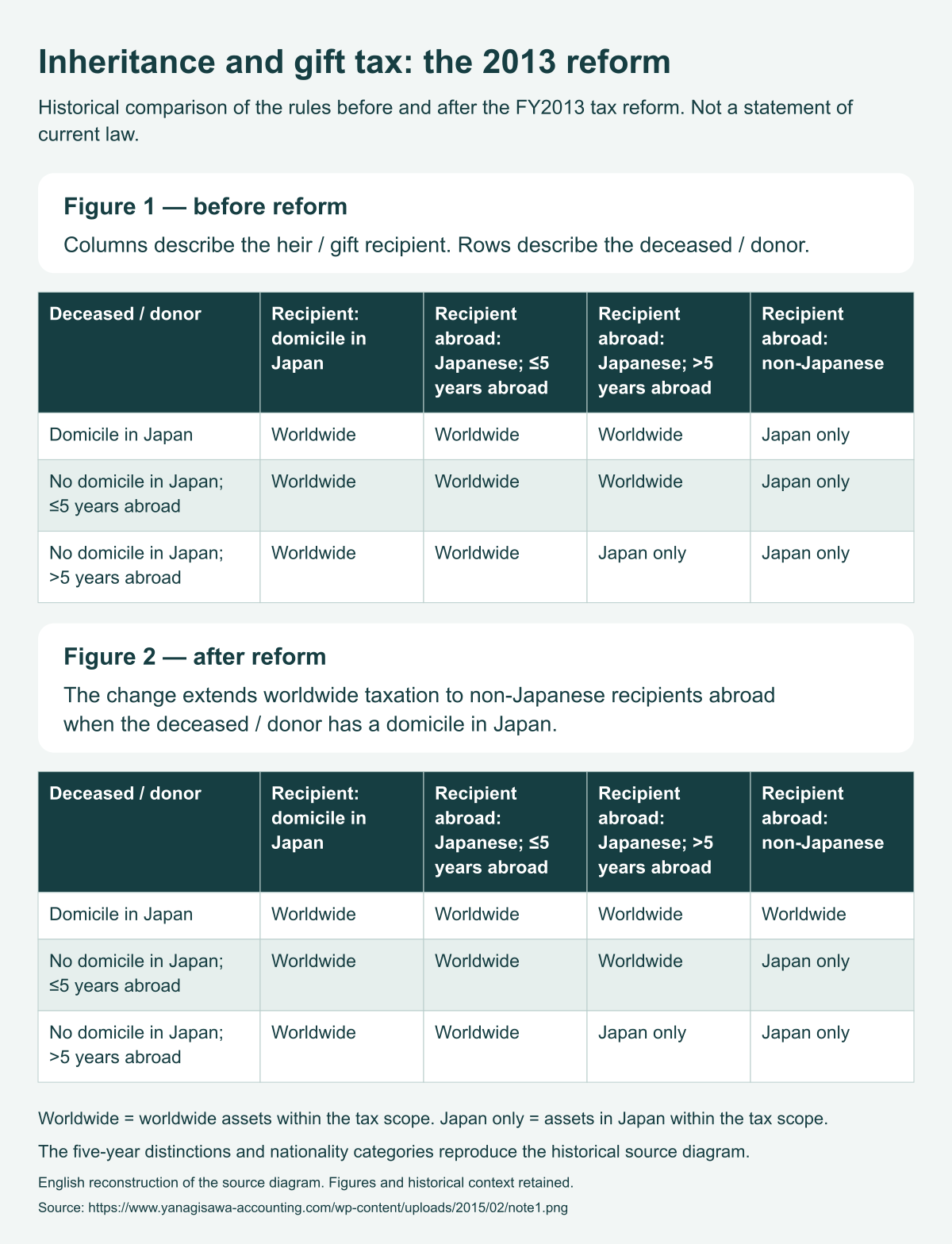
Look at the dark gray cells in the matrix above. Previously, where an heir or gift recipient had neither a Japanese domicile nor Japanese nationality, foreign property was not taxed even if the deceased or donor lived in Japan. From April 1, 2013, that property became taxable.
Thus, under the rules in 2015, gifts and inheritances of property moved abroad were untaxed in Japan only in the three situations shown in light blue.
1. Neither the heir nor the deceased, or neither the gift recipient nor the donor, has a Japanese domicile, and each has lived abroad for more than five years.
2. The heir or gift recipient has neither a Japanese domicile nor Japanese nationality, and the deceased also has no Japanese domicile but has lived abroad for five years or less.
3. The heir or gift recipient has neither a Japanese domicile nor Japanese nationality, and the deceased also has no Japanese domicile and has lived abroad for more than five years.
My personal view of this tightening is thatwealthy Japanese families undertaking inheritance and gift tax planning had frequently avoided tax by having recipients, such as children or grandchildren, relinquish Japanese nationality, move abroad, and receive gifts of assets transferred overseas. The tax authorities may have intended to prevent that.That is my interpretation.
(One wealthy foreign client living in Japan described the change as a serious nuisance. As an aside, the United States, United Kingdom, Germany, and France appear to use similar taxation approaches, although many countries, including some in Europe and many in Asia, have no inheritance tax at all.)
Around ten years ago, Australia was the most popular destination for wealthy Japanese emigrants because of its low living costs and rich natural environment. Following its economic growth and sharp price increases, however, Malaysia was said to be the most popular destination in 2015.
Malaysia is known for its MM2H visa, but that is a topic for another occasion.
Returning to the subject,
for income tax, becoming a nonresident means foreign-source income is not taxed in Japan. For inheritance or gift tax, excluding foreign property requires that neither the heir nor the deceased, or neither the recipient nor the donor, reside in Japan.
In other words,The key term in lawful international tax avoidance for wealthy Japanese individuals is therefore “nonresident.”But what do “nonresident” and “domicile” mean?
The Income Tax Act states:
(Definitions)
Article 2: In this Act, the terms listed in the following items have the meanings prescribed in those items.
(v) Nonresident: An individual other than a resident.
This is a very simple provision. If a person is not classified as a resident for tax purposes, they are a nonresident.
A resident is defined in the same Article 2, Paragraph 1.
(iii) Resident: An individual who has a domicile in Japan or has continuously maintained a residence in Japan for one year or longer up to the present.
A nonresident is therefore an individual who has no domicile in Japan and has not continuously maintained a residence here for one year or longer up to the present.
We often hear, “Removing my resident registration makes me a nonresident, right?” or “Living overseas for at least 183 days a year makes me a nonresident, right?” Both are incorrect.
Removing resident registration is a procedure under the Basic Resident Registration Act and does not determine status under the Income Tax Act. However, it relates to local taxation, and where there is genuine overseas residence and proper procedure, tax assessed as of January 1 of the following year is not imposed.
The frequently misunderstood 183-day rule appears in tax treaties and foreign tax systems, not Japan's Income Tax Act. In tax treaties, it generally concerns taxing rights over employment income, rather than determining residence status.
Ultimately, a nonresident is simply an individual with no domicile in Japan who has not continuously maintained a residence here for one year or longer up to the present.
What, then, are domicile and residence, if resident registration does not determine them?
These are understood by reference to the Civil Code, technically described as concepts borrowed from civil law.
The Civil Code states:
(Domicile)
Article 22: A person's principal place of living is their domicile.
(Residence)
Article 23: Where a person's domicile is unknown, their residence is deemed their domicile.
2. For a person without a domicile in Japan, their residence in Japan is deemed their domicile, regardless of Japanese or foreign nationality. This does not apply where the law governing their domicile must be applied under legislation determining the applicable law.
Domicile therefore means the principal place of living. Residence is not expressly defined here, but broadly means a place where someone lives that falls short of being their principal home.
For income tax purposes, a person should therefore be treated as a nonresident if their principal place of living is not in Japan and they have not continuously lived here, even in a hotel or similar accommodation, for one year or longer up to the present.
Next, let us also check the Inheritance Tax Act.
It states:
(Persons Liable for Inheritance Tax)
Article 1-3: A person falling under any of the following items is liable for inheritance tax under this Act.
(i) An individual who acquires property by inheritance or bequest, including a gift taking effect upon the donor's death, and has a domicile in the territory where this Act applies at the time of acquisition.
(ii) Any of the following persons who acquires property by inheritance or bequest and has no domicile in the territory where this Act applies at the time of acquisition:
(a) An individual with Japanese nationality, limited to cases where that individual or the deceased relating to the inheritance or bequest, including a person making a bequest, had a domicile in the territory where this Act applies at any time during the five years before the inheritance began.
(b) An individual without Japanese nationality, limited to cases where the deceased relating to the inheritance or bequest had a domicile in the territory where this Act applies when the inheritance began.
(iii) An individual who acquires property located in the territory where this Act applies by inheritance or bequest, has no domicile there at acquisition, and is not covered by the preceding item.
(iv) An individual who acquires by gift, excluding a gift taking effect upon the donor's death, property subject to Article 21-9, Paragraph 3, and is not covered by the preceding three items.
That is a long provision.
Simplified, Item (i) corresponds to all three matrix cells where the heir has a Japanese domicile. Item (ii)(a) corresponds to the five cells other than light blue where the heir has no Japanese domicile but has Japanese nationality. Item (ii)(b) corresponds to the one dark gray cell where the heir has neither a Japanese domicile nor Japanese nationality. Item (iii) corresponds to the three light blue cells.
The same applies to gifts.
(Persons Liable for Gift Tax)
Article 1-4: A person falling under any of the following items is liable for gift tax under this Act.
(i) An individual who acquires property by gift and has a domicile in the territory where this Act applies at the time of acquisition.
(ii) Any of the following persons who acquires property by gift and has no domicile in the territory where this Act applies at the time of acquisition:
(a) An individual with Japanese nationality, limited to cases where that individual or the donor had a domicile in the territory where this Act applies at any time during the five years before the gift.
(b) An individual without Japanese nationality, limited to cases where the donor had a domicile in the territory where this Act applies at the time of the gift.
(iii) An individual who acquires by gift property located in the territory where this Act applies, has no domicile there at acquisition, and is not covered by the preceding item.
Following these classifications, Article 2 defines the scope of property subject to inheritance tax, and Article 2-2 defines the scope subject to gift tax.
(Scope of Property Subject to Inheritance Tax)
Article 2: Persons covered by Article 1-3, Item (i) or (ii) are subject to inheritance tax on all property acquired by inheritance or bequest.
2. Persons covered by Article 1-3, Item (iii) are subject to inheritance tax on property acquired by inheritance or bequest that is located in the territory where this Act applies.
(Scope of Property Subject to Gift Tax)
Article 2-2: Persons covered by Article 1-4, Item (i) or (ii) are subject to gift tax on all property acquired by gift.
2. Persons covered by Article 1-4, Item (iii) are subject to gift tax on property acquired by gift that is located in the territory where this Act applies.
Combining these provisions produces the matrix discussed earlier. Ultimately,if the aim is to avoid Japanese inheritance or gift tax on assets moved abroad, nationality and domicile remain crucial.Those are the decisive considerations.
Many readers will know the Takefuji gift tax case, in which the taxpayer's victory became final at the Supreme Court on February 18, 2011 and approximately JPY200 billion, including refund interest, was returned by the government. The central issue in that litigation was the meaning of domicile.
The taxpayer won in the District Court, lost in the High Court, and then won again when the Supreme Court reversed the result.
The government, which ultimately lost, argued in part that the taxpayer had a Japanese domicile under a dual-residence concept despite spending roughly two-thirds of each year abroad. However, the government's defeat does not mean thatthis judgment guarantees recognition of having no Japanese domicile merely because someone spends roughly two-thirds of the year abroad.。
The case involved many issues beyond days spent overseas, and tax litigation is often highly dependent on individual facts.
Under the law in 2015, even after assets had been moved abroad, a finding that the owner, deceased, or donor had a Japanese domicile could subject the resulting income, inheritance, or gift to Japanese tax. That could leave someone saying, “After all the effort of moving my assets abroad,” “After all the effort of living overseas,” or “After all the effort of relinquishing nationality.”
(In the Takefuji gift tax case, more than 11 years elapsed between the actual gift and the Supreme Court judgment.)
Tax risk cannot be eliminated while governments retain taxing powers. Studying past judgments, however, helps identify the factors needed to minimize the risk of being treated as a resident or as having a Japanese domicile.
If litigation arises, the existence and extent of documentary evidence are extremely important. To prepare for a later challenge to nonresident status, it is important to document relevant facts and create evidence while actually a nonresident.
To establish that documents were not created retrospectively, it is advisable to use certified dates from Japanese notarial offices or date-certification systems provided by public authorities overseas.
Our office has prepared a 21-Point Checklist for Those Seeking Recognition as Nonresidents, based on research into past judgments. Please contact us for specific advice on the Income Tax Act, Inheritance Tax Act, nonresident status, or domicile.
This is historical material concerning the system in 2015. On September 7, 2026, notes were corrected to avoid confusion between the former and current systems. Current taxation must be assessed according to nationality, domicile history, the status of the deceased or donor, and other factors.
We take care in preparing this information. If you notice an error, please let us know through our contact page.
If You Would Like Advice on Your Own Circumstances
We advise on international tax, including overseas relocation, foreign corporations, cross-border inheritance, and foreign tax credits.
International Tax ConsultationSee consultation topics, fees, and how to book.