
Does profit ensure a high sale price? Profit matters, but buyers do not acquire past earnings.They acquire a system capable of generating future income and business valueIt is.
Look beneath identical profit figures
For illustration, consider Companies A and B, each earning JPY20 million annually before tax. These are not actual companies.
| To be confirmed | Company A | Company B |
|---|---|---|
| Sales | Depends on the president's personal network | Several employees manage customer relationships |
| Contracts | Important terms are verbal | Terms and renewal dates can be verified |
| Earnings quality | Substantial one-off income | Generated by recurring business |
| Transition | Operations stop when the president leaves | Employees and records support continuity |
This table alone does not prove B commands a higher price. A may own unique technology, while B's market may be shrinking. But the risks requiring buyer review differ.
Do not simply project current profit forward
If the founder works long hours for low pay, sustaining profit may require replacement management or additional employees. Projecting past earnings without these costs misstates earning capacity.
Conversely, a one-off relocation expense this year need not recur next year.Separate recurring items from one-offs. This is the starting point for explaining figures to buyers.
Acquisition investigation is called due diligence. It reviews financial, tax, legal, and other matters to assess price and contract terms. Basic procedures appear in the SME Agency's SME M&A Guidelines But I can check.
Different buyers may assign different values
A product company weak in customer acquisition may partner with one having a sales network. Revenue may grow, but training, systems integration, and customer support cost money. Deduct the time and costs required from expected sales growth.
METI's materials on business collaboration also identify imbalanced intellectual-property contracts as an issue. What the company owns and what depends on others' permission should be checked separately from earnings.
Bring the president's working arrangements back into the profit calculation
Consider Company A more specifically. Suppose its JPY20 million annual pre-tax profit includes JPY3 million founder remuneration as an expense. If retirement requires a replacement costing JPY10 million, unchanged other conditions reduce pre-tax profit by JPY7 million to JPY13 million. These are illustrative assumptions.
This is a post-acquisition operating projection, not an arbitrary revision of taxable profits. It changes with whether one successor, several people, or temporary founder involvement is needed. Present historical accounts separately from forecasts to clarify negotiation assumptions.
Examine both concentration percentages and customer contracts
Even if one customer accounts for half of revenue, that percentage alone is insufficient. Are orders short-term and repeatedly contested, or covered by an ongoing contract? What permits termination? Does the relationship depend on the president personally or on product performance?
Even long-term contracts may permit early termination or repricing. For major customers, assemble contracts, recent trading history, responsible staff, and renewal plans. This explains continuity beyond a concentration table.
Preparation requires more than an impressive company presentation. Monthly results must reconcile to books, key contracts must be accessible, and product rights verifiable. Identifying unresolved items and correction dates facilitates review more than hiding gaps to improve appearance.
Reported net assets may also need verification
Examine both annual profit and the balance sheet's assets and liabilities at a point in time. Recognized sales and profit do not capture reality if payment cannot be collected.
The diagram below, “An Illustration of Financial Due Diligence,” comes from Kenji Yanagisawa's 10 Checkpoints for Successful M&A: A Guide to Peace of Mind. The left shows the position before review; the right shows latent asset losses and unrecorded liabilities identified in diligence.
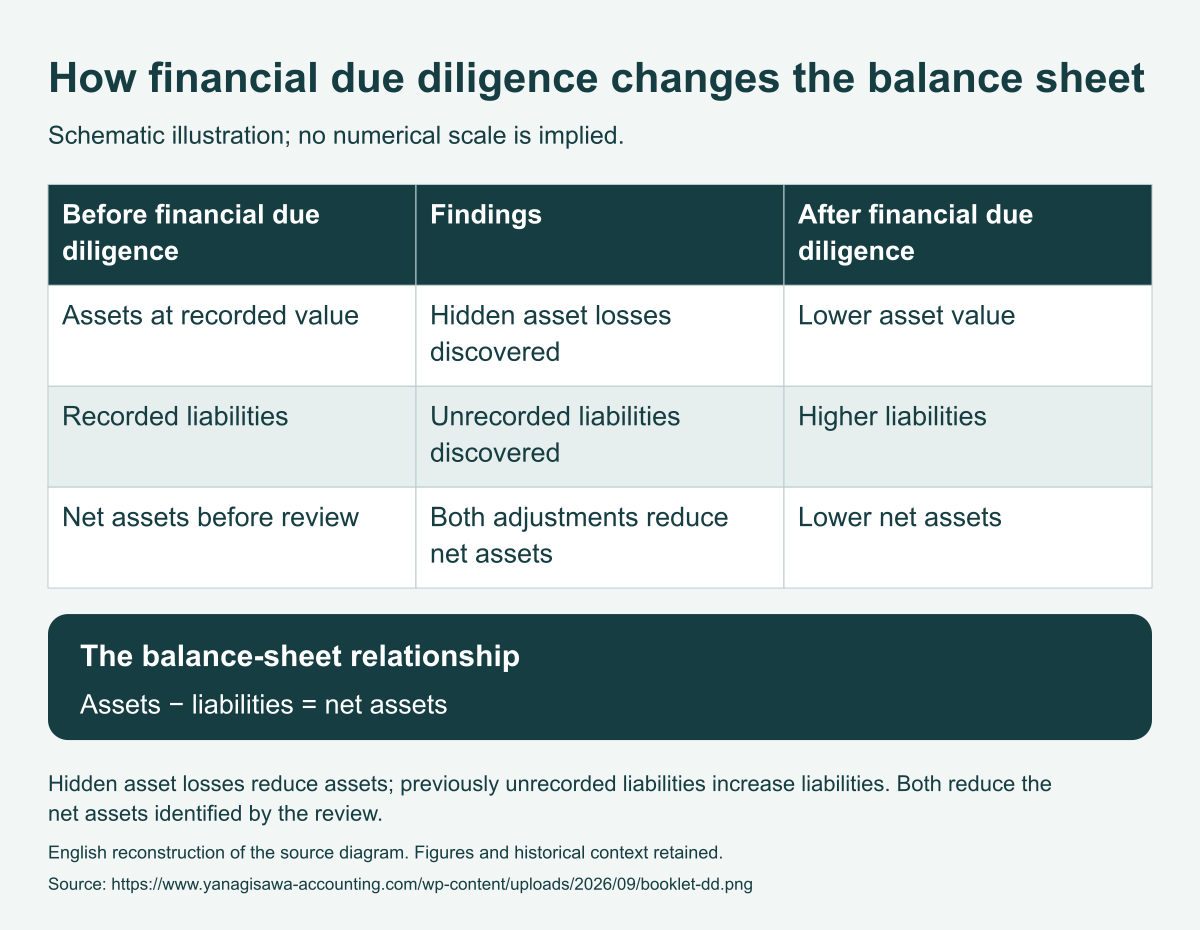
For example, JPY100 million recorded assets less JPY40 million liabilities gives JPY60 million net assets. Suppose JPY20 million of assets cannot be collected or realized and JPY10 million unrecorded liabilities emerge. Excluding tax effects, adjusted assets of JPY80 million less liabilities of JPY50 million leave JPY30 million net assets.
Latent losses may include doubtful receivables or unsaleable inventory; off-book liabilities are unrecorded payment obligations. Adjustments require evidence such as contracts and recoverability assessments. The diagram does not imply every review finds these issues.
Adjusted net assets of JPY30 million do not automatically become the share sale price.Future earnings, buyer synergies, and contract terms also affect price. Track where each issue is reflected to avoid duplication between earnings forecasts and price adjustments.
The booklet also lists not hiding information as a checkpoint. Explaining known issues and responses aligns assumptions more readily than leaving the buyer to discover them later. Sale preparation includes explaining weak points in figures, not merely presenting favorable numbers.
Imagine the buyer and preserve value in the company
My suggestion is to list what remains when you leave before listing buyer names: customer contracts, product rights, employee capabilities, procedures, and accumulated data. Which support revenue and profit?
Then verify that each belongs to the company and is transferable. Business value can exist without recognition as a balance-sheet asset. Conversely, knowledge only in the founder's head needs transition preparation.
Grow annual earnings while building a company others can take over.Even without an urgent sale, this perspective helps identify weaknesses.
This manuscript is a general explanation based on laws and regulations as of September 9, 2026. Please obtain advice on your individual circumstances before taking action.
We take care in preparing this information. If you notice an error, please let us know through our contact page.
If You Would Like Advice on Your Own Circumstances
We advise on startup preparation, business planning, financing, and building accounting systems.
Entrepreneur and Startup SupportSee consultation topics, fees, and how to book.