
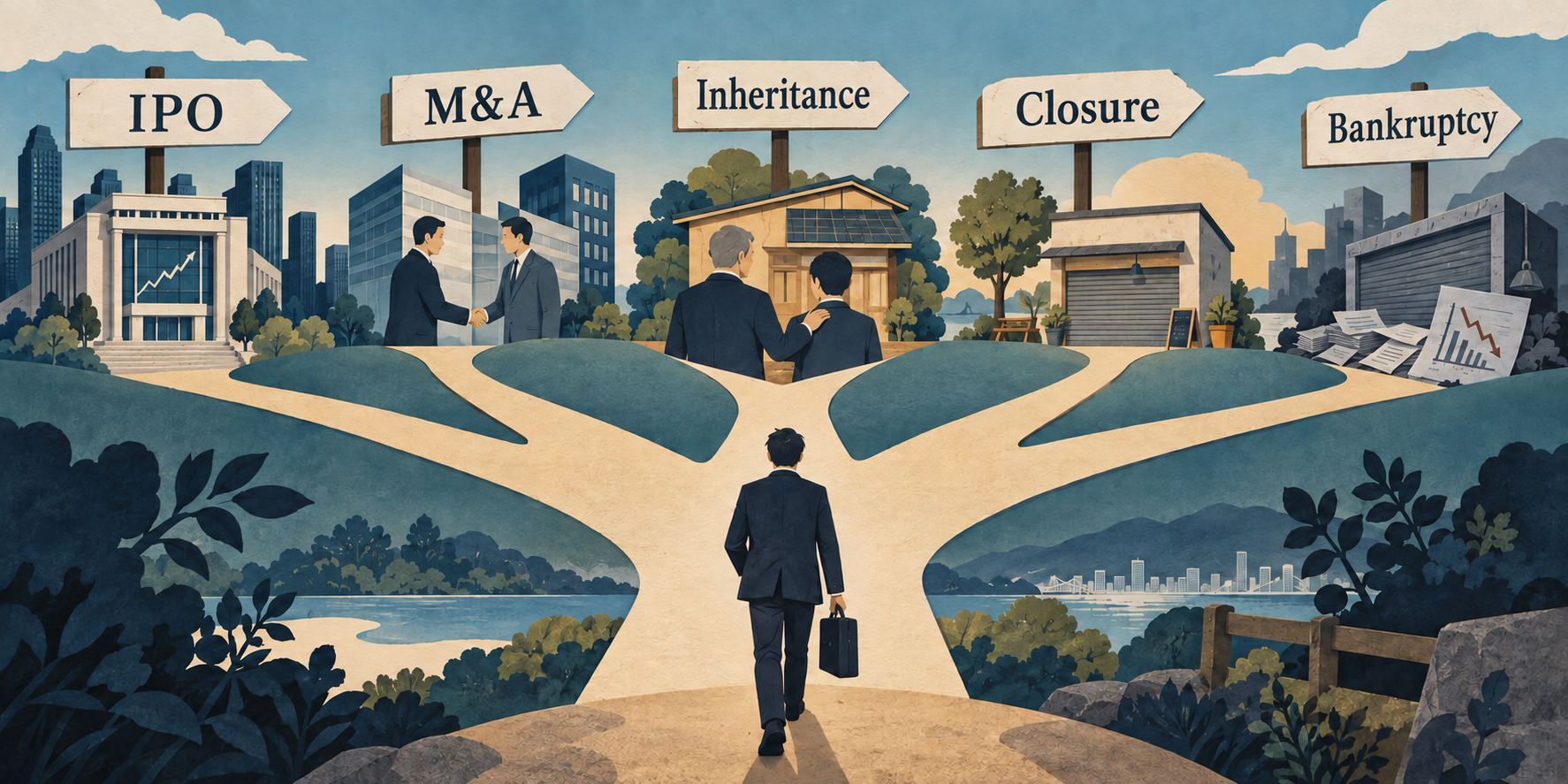
When starting a company, you consider what to sell and how to find customers. But have you considered your eventual relationship with the company?
The company and founder's future can be organized into five directions: IPO, M&A, inheritance, closure, and insolvency.Here, lifetime gifts and similar succession are grouped with inheritance. This is a planning framework, not an exhaustive legal classification.
Between starting a company and ending one
| Outcome | What founders should consider |
|---|---|
| IPO | Grow with public-market shareholders |
| M&A | Transfer the company or business to a buyer |
| Inheritance | Transfer shares through inheritance or lifetime gifts and decide who manages |
| Business closure | End operations and settle assets, liabilities, and contracts |
| Insolvency | Address financial failure such as inability to pay |
These paths overlap. A listed company may undertake M&A, and an inherited company may be sold. Insolvency includes rehabilitation, not necessarily disappearance. Paid transfers to managers or employees can be treated broadly as M&A. Since an IPO is not a founder's complete departure, “exit” here includes the next stage of ownership or management.
The framework still matters. Few founders initially aim for closure or insolvency. Unless planning succession to the next generation,build a company whose value can be explained to others, with IPO or M&A in view. This series takes that perspective.
Listing is not the day the founder becomes free
An IPO makes shares tradable on an exchange. New-share proceeds go to the company; proceeds from the founder's existing shares go to the founder. These are distinct, and listing does not turn all founder shares into cash.
If continuing to manage after listing, the founder must explain performance and decisions to many shareholders. The Tokyo Stock Exchange's Growth Market listing examination also reviews appropriate disclosure, internal controls, and reasonable business plans. Revenue growth alone does not complete preparation.
Do not treat M&A only as a fallback if listing fails
M&A does not necessarily mean retirement. It can expand the business using a buyer's distribution, funding, and people. METI's 2026 Startup M&A Guidance also treats IPO and M&A as growth routes chosen according to company circumstances.
Consider a company with an excellent product but insufficient time or money to build nationwide sales offices. Should it raise funds and expand independently or join a company with distribution? There is no single answer; compare capital needs, timing, and management freedom.
Consider the company's future and your own life together
Separate what you want for the company from how you want to work. You may want growth while focusing on product development, a new venture after reaching a certain scale, or long-term management followed by succession. Each requires different people and shareholder relationships.
For example, one founder may envisage a sale in a few years while another wants lifelong management. Neither is inherently wrong, but equal shareholding without discussion can create disagreement when an offer arrives. Clarify the purpose of founding together before dividing equity.
Ownership, management, and daily work are also distinct. You may retain shares and delegate management. In this framework, that remains a stage before final share succession or sale. Do not confuse leaving the presidency with relinquishing ownership.
Customers do not pay for your exit ambitions
Aiming for an IPO or M&A does not establish a business. Customers pay because a problem is solved. Exit planning helps determine how far to grow that value and with whom to transfer it.
I recommend connecting customer value, value accumulated in the company, and the founder's desired future. Should an immediate sale justify giving away important product rights? Can employees inherit growing custom work? Exit thinking adds perspectives beyond current revenue.
Let the exit influence today's decisions
For an IPO, build repeatable growth and explainable management systems. For M&A, identify what buyers must inherit to realize value. A company dependent on the founder's sales differs from one earning through employees and systems. Today's hiring, contracts, and work design create that difference.
You need not choose the buyer or listing date immediately. But equity recipients and contractual terms are difficult to reverse. Short-term funding decisions can narrow future options.
At formation, put your provisional exit plan on one page.IPO or M&A? What must be built? Does the founder want to keep managing afterward? I recommend asking these questions before developing the business plan and equity financing strategy.
This manuscript is a general explanation based on laws and regulations as of September 9, 2026. Please obtain advice on your individual circumstances before taking action.
We take care in preparing this information. If you notice an error, please let us know through our contact page.
If You Would Like Advice on Your Own Circumstances
We advise on startup preparation, business planning, financing, and building accounting systems.
Entrepreneur and Startup SupportSee consultation topics, fees, and how to book.