
Last year, Facebook CEO Mark Zuckerberg attracted attention by establishing his own foundation.
Original Japanese source material.
Is Zuckerberg's Donation Hypocritical?
On December 1, Mark Zuckerberg, CEO of Facebook, the social network with the world's largest user base, made two announcements to the world.
First, his eldest daughter Maxima had been born. Second, he announced that he would donate 99% of his Facebook shares, reportedly worth USD45 billion (approximately JPY5.5 trillion), to charitable causes in the future, without specifying a timeframe. Ninety-nine percent of his wealth is an enormous amount. Even for a billionaire, his generosity drew praise from around the world.
Here are some comments posted on Twitter by The New York Times.
“There are many billionaires, but no one can do what he has done.”
“I had stopped using Facebook for a while, but I'm coming back.”
“The birth of your beloved daughter changed your outlook on life. Wonderful.”There were also negative responses. Not everyone unreservedly praised the large donation.
“So he's found a way to escape capital gains tax on securities. Charity? Don't make me laugh.”
“I don't like that the recipient is his own foundation.”
“I just hope the money doesn't end up funding Islamic State.”
Envy or jealousy may underlie some negative comments, but there is undoubtedly a tax planning aspect. At the same time, it cannot be conclusively said that this charitable activity is merely superficial hypocrisy. (Remainder omitted)
Source: Nikkei Business Online

As this article suggests, establishing a foundation can be seen as“a way to escape capital gains tax on securities” and “undoubtedly having a tax planning aspect.”These are among the views expressed.
What kind of tax planning can establishing a foundation provide?
Japan has long had a system of incorporated foundations.
Originally, foundations could be established for public interest purposes under the Civil Code. The 2008 reform of the public interest corporation system made it possible to establish general incorporated foundations without a public interest purpose.
To put the visible difference simply, registration records for foundations established by 2008 state only “incorporated foundation,” while those established under the reformed system state either “general incorporated foundation” or “public interest incorporated foundation.”
Another feature is that a public interest incorporated foundation first begins as a general incorporated foundation under the Act on General Incorporated Associations and General Incorporated Foundations. Only after the Cabinet Office or a local government certifies its public interest status under the Act on Authorization of Public Interest Incorporated Associations and Public Interest Incorporated Foundations does it become a public interest incorporated foundation.
Now, let us turn to taxes.
“Public interest corporation” collectively refers to public interest incorporated foundations and associations. The Cabinet Office website below clearly shows the available tax benefits. Some general incorporated associations and foundations also qualify as nonprofit-type corporations with a degree of public interest character, but those are not discussed in detail here. The comparison below shows that, viewed solely in terms of tax benefits, public interest corporations have a wider range of benefits than nonprofit-type corporations.
 Original Japanese source material.
Leaving detailed incentives aside, the key provisions concern (1) taxation of the corporation itself—corporation tax on profit-making activities—and (2) donation incentives, including individual income deductions, exemption from capital gains income tax when individuals donate property, and inheritance tax exemption when inherited property is donated. Ultimately,the corporation itself is not taxed, and the income, property, and inherited property donated to it by individuals can also escape taxation.In other words,tax benefits can be obtained under all three major national tax laws: corporation tax, income tax, and inheritance tax.This can produce remarkably substantial tax effects.
Simply put, establishing a public interest corporation can make the following possible.
(1) Activities certified as public interest activities under the Authorization Act are exempt even if they would otherwise be profit-making business activities. In other words, no corporation tax applies.
(2) Individuals donating to the public interest corporation can claim an income deduction or income tax credit, much as when donating to the Red Cross or similar organizations.
(3) Property bequeathed to the public interest corporation according to the deceased's wishes, or inherited property donated under specified conditions, does not give rise to inheritance tax.
(However, taxation risks arise if the arrangement is considered improper tax avoidance under the Income Tax Act or Inheritance Tax Act. Careful consideration, including professional advice, is necessary.)
Public interest activities under the Authorization Act are limited to the categories listed in its appended table below, so the activity must fall within one of them.
(i) Activities promoting scholarship, science, and technology
(ii) Activities promoting culture and the arts
(iii) Activities supporting people with disabilities, people in financial hardship, or victims of accidents, disasters, or crime
(iv) Activities promoting the welfare of older people
(v) Activities supporting employment for people willing to work
(vi) Activities improving public health
(vii) Activities promoting the healthy development of children and young people
(viii) Activities improving workers' welfare
(ix) Activities contributing to people's healthy physical and mental development through education, sports, and similar means, or nurturing well-rounded humanity
(x) Activities preventing crime or maintaining public safety
(xi) Activities preventing accidents or disasters
(xii) Activities preventing and eliminating unjust discrimination or prejudice based on race, sex, or other grounds
(xiii) Activities respecting or protecting freedom of thought and conscience, freedom of religion, or freedom of expression
(xiv) Activities promoting a gender-equal society or otherwise creating a better society
(xv) Activities promoting international mutual understanding and economic cooperation with developing regions overseas
(xvi) Activities conserving the global environment or protecting and improving the natural environment
(xvii) Activities concerning the use, development, or conservation of national land
(xviii) Activities helping ensure sound national governance
(xix) Activities promoting the sound development of local communities
(xx) Activities securing and promoting opportunities for fair and free economic activity and improving the stability and quality of people's lives through its revitalization
(xxi) Activities ensuring stable supplies of goods, energy, and other essentials for people's lives
(xxii) Activities protecting or promoting the interests of general consumers
(xxiii) Other public interest activities prescribed by Cabinet Order
In a sense,Something resembling a tax haven existed much closer to home than distant offshore jurisdictions.That discovery can feel startling, but the comparison may not be entirely exaggerated.
As their name suggests, public interest corporations serve public purposes and are expected, like the state, to perform a redistributive function. To stretch the analogy slightly, establishing one might be compared to creating something like a small country of your own within Japan.
In addition to the Cabinet Office website above, the following resources are useful for learning more about the public interest corporation system.
Ministry of Justice Website: Q&A on General Incorporated Associations and General Incorporated Foundations
Ministry of Finance Website: Principal Tax Treatment of Public Interest Corporations and Similar Entities
National Tax Agency Website: Guide to the New Tax System for Public Interest Corporations
How are these seemingly ideal public interest corporations, with benefits across all three major national taxes, actually used?
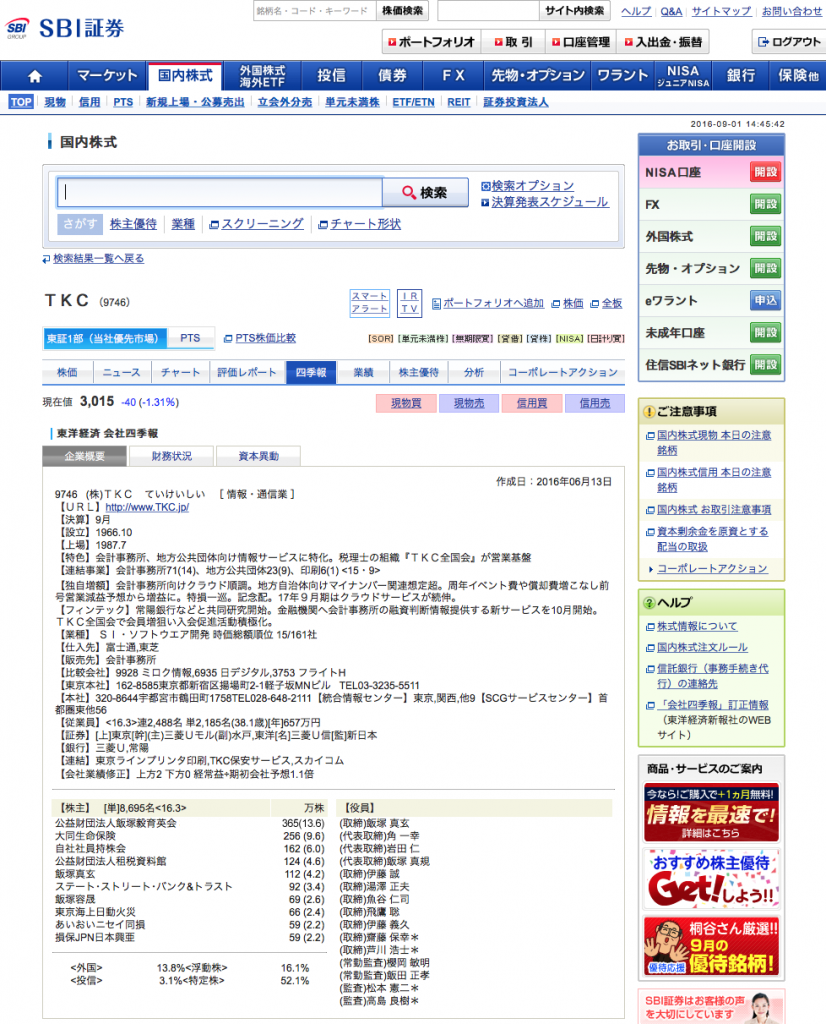
Below is the shareholder list for TKC Corporation, a company listed on the First Section of the Tokyo Stock Exchange.
 Original Japanese publication.
TKC was founded in 1966 by the late Takeshi Iizuka, a charismatic certified public accountant and tax accountant, and was a pioneer in computerized accounting. Many accountants and tax accountants participate in the TKC National Federation, formed in 1971, creating what might be described as a collective body of accounting and tax knowledge. Our office is not a TKC member.
Let us look closely at the shareholder list of TKC, a company with extensive accounting and tax expertise.
Its largest and fourth-largest shareholders are public interest incorporated foundations.
Largest Shareholder Takeshi Iizuka Scholarship Foundation 3.65 million shares (13.6%)
Fourth-Largest Shareholder Tax Museum Foundation 1.24 million shares (4.6%)
These two foundations were presumably established to continue socially beneficial activities beyond the company the founder created—TKC in Takeshi Iizuka's case—and beyond his lifetime. But why are they major shareholders in TKC?
It is easy to infer that Iizuka's TKC shares were transferred to the foundations through donations, bequests, or donations of inherited property.
In that case, as discussed earlier, income tax and inheritance tax do not arise.
For owner-managers whose own company shares form a large portion of their wealth, an inheritance without advance planning may require selling those shares to fund inheritance tax.
For listed companies, shares can be sold on the market, so a solution remains possible. For unlisted companies, the situation is more difficult and may require converting the shares into cash through an M&A transaction or similar means.
(Recently, the business succession tax system has introduced certain tax deferrals for unlisted companies where an heir becomes the successor.)
The conclusion is that a public interest corporation structure can be highly effective where an unavoidable sale of company shares following inheritance would affect control of the business.
Transferring the shares to a public interest corporation without selling them can secure a stable shareholder.
If you have a copy of the Japan Company Handbook, look at the shareholder section for each company.
You will find public interest incorporated foundations among the shareholders of many listed companies.
A well-known example is Miki Watanabe of Watami. He appears to have at least three foundations.
Minna no Yume wo Kanaeru Kai Public Interest Incorporated Foundation
School Aid Japan Public Interest Incorporated Foundation
Save Earth Foundation Public Interest Incorporated Foundation
Yusaku Maezawa, founding president of Start Today, listed on the First Section of the Tokyo Stock Exchange and known as a contemporary art collector, also appears to have a foundation.
 Original Japanese source material.
Other examples include the foundation established by Osamu Shigematsu, founder of United Arrows, also listed on the First Section of the Tokyo Stock Exchange: Japan Fashion and Lifestyle Foundation among others.
Research reveals an enormous number of public interest incorporated foundations in Japan.
Some are older foundations established under the Civil Code whose founders have already died; others are younger foundations established after the reform whose founders remain active. Where an owner-manager is the founder, the motivations may combine a desire for social contribution with tax planning that protects company shares.
Of course, public interest corporations are fundamentally vehicles for public interest activities, rather than entities created for company share planning. In that respect, Aya Sugimoto's Eva Animal Environment and Welfare Association Public Interest Incorporated Foundation is also a useful example.
Returning to company share planning, the Unlisted Companies edition of the Japan Company Handbook offers a more specialized perspective. Its shareholder sections also reveal a number of public interest incorporated foundations.
For example, a major shareholder of Echigo Kotsu Co., Ltd. is the Kakuei Tanaka Memorial Museum Public Interest Incorporated Foundation. These well-known examples are used for clarity, but many less familiar foundations also exist.
Thus, regardless of whether their companies are listed, a considerable number of owner-managers appear to know about and have adopted this public interest corporation structure.
A common question concerns listed-company owners who use asset management companies to hold their company shares and become major shareholders. How does that structure differ?
An asset management company uses inheritance tax valuation rules to reduce inheritance tax while providing a stable shareholder; it cannot eliminate inheritance tax entirely. In that respect, it is less advantageous than a public interest corporation structure. In exchange, the next generation can inherit the listed shares that would otherwise become the public interest corporation's property, so each approach has advantages and disadvantages for successors.
Each case requires individual examination, and combining asset management company and public interest corporation structures is also possible.
Japan's foundation system derives from the Civil Code enacted in 1896. That Code drew on the civil codes of European countries, so the foundation concept in Japan can be seen as an import from Europe.
The foundation established by Mark Zuckerberg is presumably based on U.S. law. As in Japan, his motivations may include both public interest activities and planning for his own company shares.
Our office works with judicial scriveners and administrative scriveners specializing in registration and public interest certification, with experience in hundreds of public interest corporation matters. We offer individual consultations to owner-managers considering public interest corporations as part of planning for shares in their own companies. Direct consultations are charged from the first session.
Please feel free to use our services.
Consultations and Engagements
Individual, case-specific consultations are charged from the first session. For current consultation scope, fees, and application procedures, see Our Services. Fees for ongoing support and individual engagements are quoted separately according to the work involved.
Related Articles:
Accounting and Taxation for Public Interest Corporations
Public Interest Corporation Tax Impact Simulation
This paper is a general explanation based on laws and regulations as of September 12, 2026. Please always consult individually before implementation.
We take care in preparing this information. If you notice an error, please let us know through our contact page.
If You Would Like Advice on Your Own Circumstances
We provide tax advice suited to your circumstances, including returns, inheritance, and company taxation.
Japanese Tax ConsultationsSee consultation topics, fees, and how to book.