
On July 9, 2024, the Ministry of Finance published its Explanation of the FY2024 Tax Reforms. It included revisions to the special rules reducing the tax book value of subsidiary shares following receipt of dividends from the subsidiary. Ministry of Finance Publication History and FY2024 Tax Reform Commentary, Pages 753–755
SoftBank Group's restructuring after acquiring Arm offers an instructive example of this regime. Value was extracted from a subsidiary through a dividend, then shares in the reduced-value subsidiary were transferred. Applying dividend and share disposal tax rules separately could create a loss reducing Japanese taxable income even though the investment's value had been recovered.
This article explains the mechanism while distinguishing transactions established by company disclosures from published expert analysis. It then traces the regime's introduction in FY2020, adjustments in FY2022, and the FY2024 amendment. The information is as of July 9, 2024.
1. First, What Was the Issue?
The key is the combination of two tax treatments.
- When Receiving a Dividend: Dividends from qualifying foreign subsidiaries are generally 95% excluded from taxable income.
- When Transferring Shares: If subsidiary shares retain a high tax cost after a dividend reduces their value, the difference between that cost and disposal value creates a loss.
Exclusion from taxable income means omitting revenue from the corporation tax income calculation. It does not mean crediting 95% of the tax. Tax basis is the share cost maintained for tax calculations such as disposal gains and losses; it need not match accounting carrying value or current market value.
The foreign subsidiary dividend exclusion addresses international double taxation of foreign subsidiary income and dividends paid to the Japanese parent. Generally, qualifying subsidiaries require ownership of at least 25% continuously for at least six months before the dividend payment obligation becomes fixed, subject to treaty rules and other exceptions. National Tax Agency: Foreign Subsidiary Dividend Exclusion Q&A, Questions 1 and 2
There is a reason to adjust dividend taxation. However, if the share tax basis is not sufficiently adjusted after a dividend, a mismatch can arise with a later disposal loss. This is the point the government subsequently addressed.
2. Arm Shares Do Not Refer to Just One Asset
A source of confusion in this case is calling bothshares in the former Arm holding companyAnd,shares in the underlying Arm operating companyArm shares.
| Term Used Here | Company or Organization | Role in This Case |
|---|---|---|
| SBG | SoftBank Group Corp. | Japanese parent, a separate entity from telecommunications company SoftBank Corp. |
| Former Arm Holding Company | Former Arm Holdings plc; SVF HOLDCO (UK) LIMITED in the 2018 disclosure | The acquired company that distributes shares in its subsidiary as a dividend |
| Arm Operating Company | Arm Limited | Issuer of the shares distributed as a dividend in kind |
| SVF | SoftBank Vision Fund L.P. | Fund receiving the former holding company shares as a contribution in kind |
In September 2016, SBG announced completion of its acquisition of all shares in Arm Holdings plc for approximately GBP 24 billion, or JPY 3.3 trillion. SBG Announcement of September 5, 2016
The subsequent restructuring combined a dividend of operating company shares held by the holding company with the parent's contribution of holding company shares to a fund. First recognize that the transferred shares have different issuers.
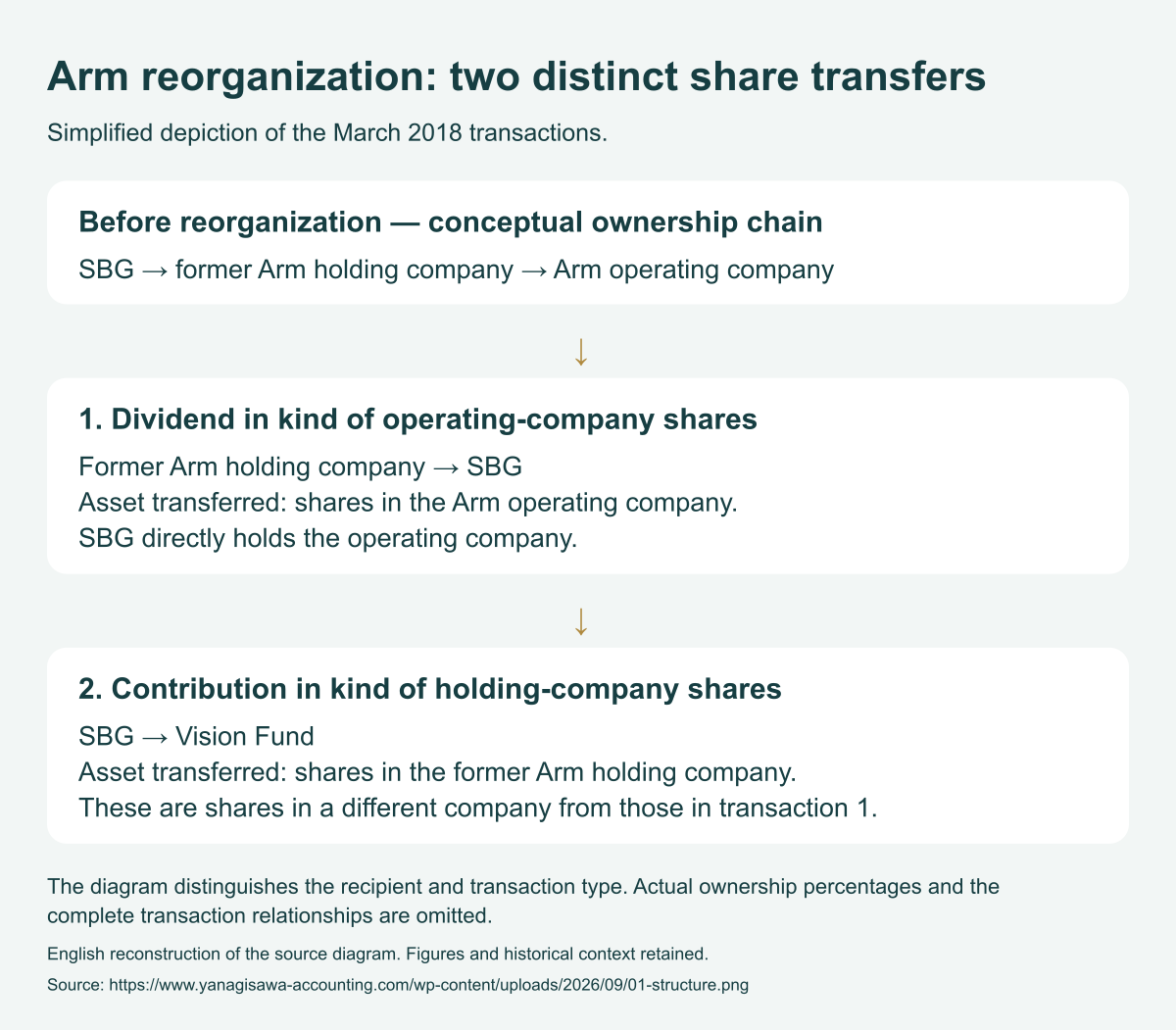
Figure 1 is a schematic of the transaction structure. Intermediate entities, ownership percentages, and detailed procedures are omitted. SVF also has outside investors and cannot be shown as SBG's wholly owned subsidiary.
3. Transactions Established by the 2018 Disclosures
SBG's online disclosures for its 38th Annual General Meeting include the following transactions for the year ended March 2018.
| Disclosure Item | Disclosed Details | Interpretive Caution |
|---|---|---|
| Dividend Received from Former Holding Company | JPY 2,546,119 Million, Approximately JPY 2.5461 Trillion | Related-party transaction disclosure amount, not tax market value or tax savings |
| Method of Receiving the Dividend | Securities Received at Carrying Value | Not an equivalent cash receipt |
| Contribution in Kind to SVF | Primarily a Contribution of SVF HOLDCO Shares | The contributed assets were former holding company shares |
| Accounting for the Contribution in Kind | Treated as if No Transfer Had Occurred | Japanese separate-accounting treatment, not an explanation of the tax treatment itself |
The source is SBG's 2018 Disclosure, PDF Pages 58, 60, and 61, corresponding to printed pages 59, 61, and 62.
This disclosure establishes a substantial dividend in kind and a contribution of former holding company shares to the fund. However, corporate financial disclosures are not corporation tax returns. The table does not establish the tax valuation of the dividend, final disposal loss calculation, or connection to tax loss carryforwards.
Nor can the approximately JPY 2.55 trillion be restated as dividend income recognized in the separate income statement. The same disclosure's income statement notes report dividends from affiliates of JPY 67,601 million, different from the transaction disclosure above.Distinguishing transaction value from the amount recognized as current accounting profit is the starting point for reading this case.
4. From a Dividend in Kind to a Share Disposal Loss
Mori Hamada & Matsumoto's tax reform commentary published in April 2020 explains the transactions then reported as follows. That Commentary, Page 2
Stage 1: Distribute Subsidiary Shares as a Dividend in Kind
The former Arm holding company distributes its Arm operating company shares to SBG. Dividends need not be cash; a company can distribute securities and other assets to shareholders.
Shigeki Morinobu's commentary dated November 15, 2019, based on reports at the time, describes the dividend as approximately 75% of the Arm operating company shares. This percentage comes from expert commentary and is distinct from figures read directly from the company disclosure table above. That Commentary, Page 1
The structure applies SBG's 95% foreign subsidiary dividend exclusion. Receiving substantial value does not put the full amount into Japanese taxable income.
Stage 2: The Former Holding Company's Value Falls After the Dividend
Distributing valuable assets outside a company reduces the property remaining in it. The market value of its shares accordingly falls.
From the parent's perspective, however, not all value has been lost. Part of the property formerly held within the subsidiary is now held separately as a dividend.
Stage 3: Contribute the Reduced-Value Former Holding Company Shares in Kind
SBG contributes its former holding company shares to SVF. Published analysis describes a tax disposal loss equal to the difference between the high acquisition cost and the reduced value at transfer.
This explanation combines the existence of the dividend and contribution in kind supported by company disclosures with tax effects described by experts. It does not mean individual tax returns were reviewed.
5. What Happens When 75 Is Extracted from a Company Bought for 100?
Set aside the actual transaction and consider the mechanism using simple figures.
Assume a Japanese parent acquires all shares in a foreign subsidiary for 100, also its value at acquisition. The subsidiary then distributes assets worth 75 to the parent, and the remaining subsidiary shares are sold at a market value of 25.
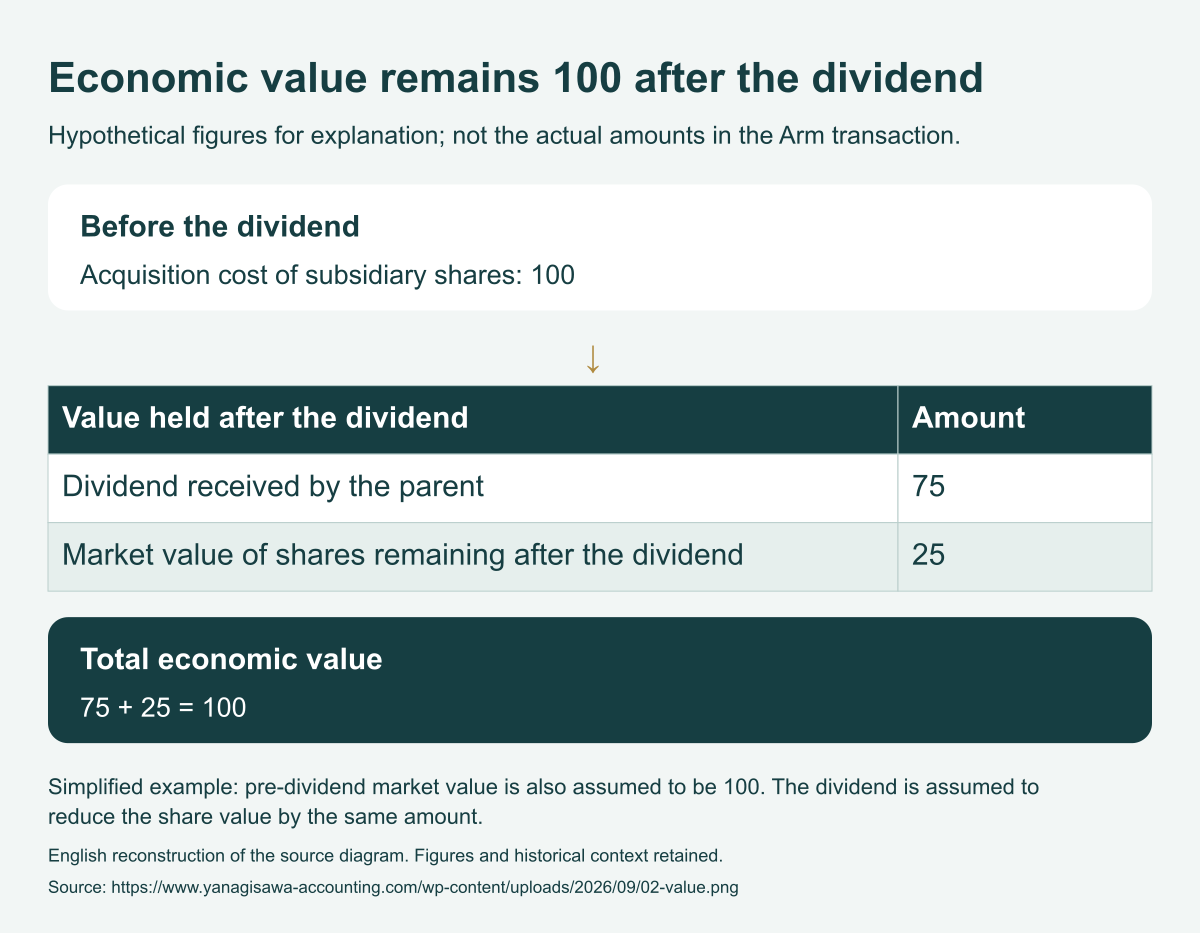
The parent recovers value of 100: a dividend of 75 plus share sale proceeds of 25. This equals the acquisition payment, so there is no overall economic investment loss in this example.
However, if 95% of the dividend of 75 is excluded from taxable income while the share tax basis remains 100, the income calculation is as follows.
| Calculation Item | Calculation | Amount |
|---|---|---|
| Dividend Excluded from Taxable Income | 75 × 95% | 71.25 |
| Taxable Portion of the Dividend | 75 − 71.25 | 3.75 |
| Share Disposal Gain or Loss | Disposal Proceeds 25 − Tax Basis 100 | −75 |
| Combined Income Effect of the Two Transactions | 3.75 − 75 | −71.25 |
Although the investment's value has been recovered, taxable income falls by 71.25. If the loss can offset other income or be carried forward, the tax impact can be substantial.
However, 71.25 is not a tax amount. Assuming immediate full utilization and a 30% marginal rate, the tax effect is 71.25 × 30% = 21.375. Actual results depend on loss utilization limits, other income, applicable rates, and the year of use.A large loss amount cannot simply be called tax savings.
Our firm prepared this numerical example for illustration; it does not reproduce SBG's transaction amounts or returns. The 75 here is an assumed amount, separate from the approximately 75% shareholding discussed above. Foreign taxation, withholding, exchange rates, acquisition costs, and post-dividend asset value changes are also omitted.
6. Why Does No Large Loss Appear in the Accounts?
A large tax loss on share disposal does not necessarily mean the financial statements show an equivalent loss. At least three calculations must be distinguished.
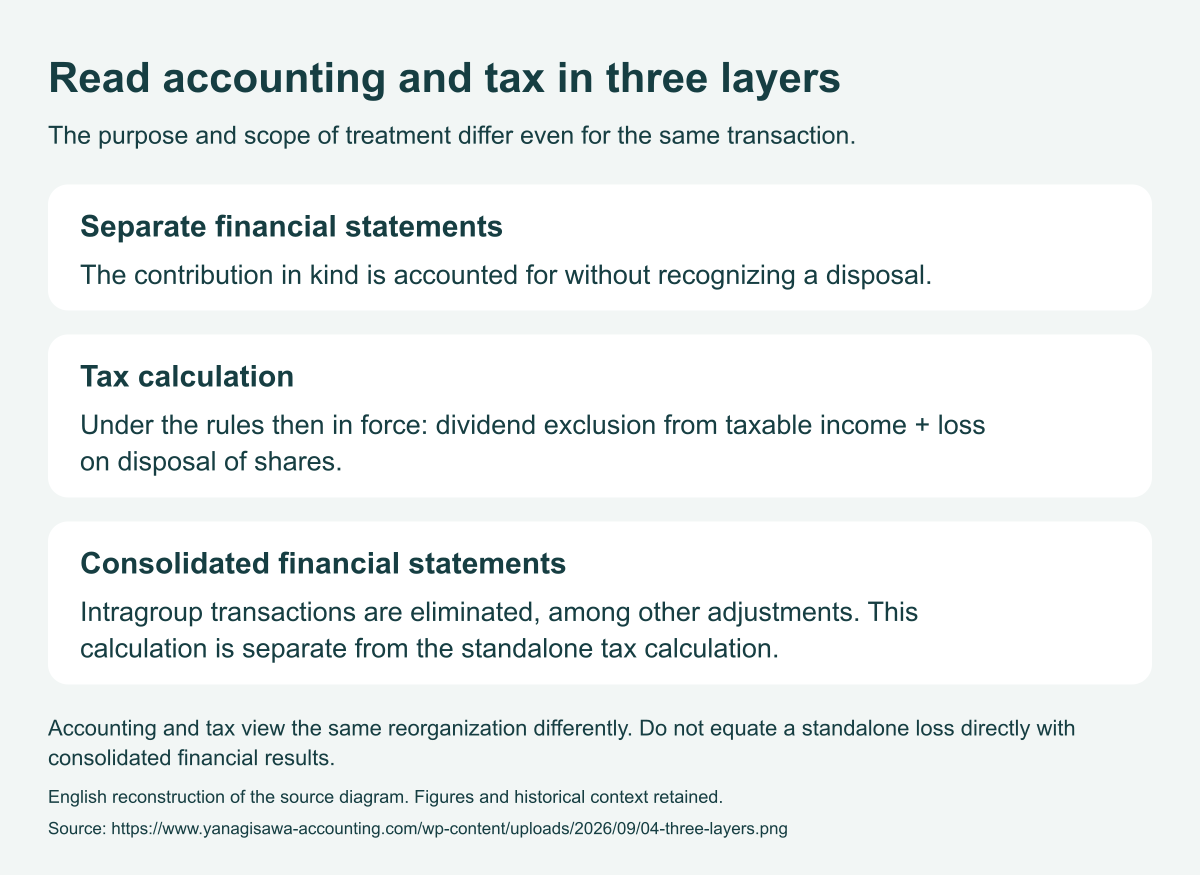
Separate Accountingshows one entity's financial position and performance. For the contribution in kind to SVF, SBG disclosed accounting treatment as though no transfer occurred. The legal transfer of shares and recognition of an accounting disposal gain or loss are different questions.
Corporation Tax Income Calculationmay start with accounting profit but includes exclusions from income, deductions, and other adjustments. Different accounting carrying values and tax bases can change whether a gain or loss arises and its amount for the same transaction.
Consolidated Accountingmakes adjustments to view the group as one economic entity. With eliminations of intragroup transactions and other adjustments, a tax loss at one entity may not appear directly in the consolidated income statement.
The disclosed dividend-in-kind amount, separate net income, consolidated pretax profit, and taxable income or tax losses on the corporation tax return are different measures. Analyzing accounting profit alongside a tax loss requires preserving these distinctions while tracing the transaction.
7. Understanding the Figure of JPY 5 Million Tax on Roughly JPY 2 Trillion Profit
For the following year ended March 2019, SBG's separate income statement shows pretax net income of JPY 1,980,425 million and corporation, inhabitant, and enterprise taxes of JPY 5 million. Deferred income taxes, meanwhile, were JPY 2,728 million. 2019 Meeting Notice, Printed Page 56 / PDF Page 57
| Year Ended March 2019: SBG Separate Accounts | Amount | What It Represents |
|---|---|---|
| Net Income Before Income Taxes | Approximately JPY 1.9804 Trillion | Accounting Pretax Profit |
| Corporation, Inhabitant, and Enterprise Taxes | 5 million yen | Current Tax Expense in the Separate Income Statement |
| Deferred Income Taxes | JPY 2.728 Billion | Tax Effect Accounting Adjustment |
| Dividends Received from Affiliates | Approximately JPY 2.0698 Trillion | Dividend Income Representing Most Operating Revenue |
The JPY 5 million figure does not mean the entire group paid only JPY 5 million in taxes. The table covers SBG's separate accounts, not taxes paid by the whole group including domestic and foreign operating companies. Income statement tax expense also need not equal cash taxes paid in that year.
It also matters that dividend income accounts for most pretax profit. Dividends may qualify for exclusion to address double taxation, so accounting profit multiplied by a tax rate is not automatically the corporation tax that should be due.
Moreover, the Arm restructuring occurred in the year ended March 2018, while the table concerns the following year ended March 2019. These disclosures alone cannot attribute all of the next year's low tax expense to the Arm restructuring.
Do Not Mix in Other Consolidated Tax Effects
SBG's consolidated accounts around the same period contain other major tax effects. The 2019 Annual Report explains that share sales accompanying telecommunications company SoftBank's listing reduced income taxes by JPY 405.577 billion through loss utilization and reversal of temporary differences at seller SoftBank Group Japan. Annual Report 2019, Printed Page 136 / PDF Page 138
The year ended March 2018 also saw a tax expense reduction from reversing Sprint's deferred tax liabilities and recognizing deferred tax assets following US tax reform. SBG Announcement of May 9, 2018
These should each be read separately from the Arm dividend in kind and share disposal loss discussed here.
8. What Do the 2019 Tax Audit Reports Show?
On June 20, 2019, Nippon Television reported that SBG had been found to have underreported more than JPY 400 billion. The article conveyed the company's explanation that the deduction belonged to a fiscal year one year later and that it had filed an amended return. Nippon Television Article of June 20, 2019
The distinctions to retain are betweenthe deduction amount, adjustment to reported income, and additional tax payable. The reported underreporting of over JPY 400 billion cannot be restated as JPY 400 billion in additional tax. Correcting deduction timing also differs from denying all tax effects of the transaction.
Public corporate disclosures alone do not establish how tax authorities considered general anti-avoidance provisions. They do not support claims that a court confirmed legality or authorities declared the entire structure lawful.
For the history of the regime, distinguish correction of a particular year's return from designing rules for similar future transactions.
9. FY2020 Reform: Reduce the Tax Basis of Shares When a Dividend Is Received
FY2020 tax reform introduced the subsidiary share basis reduction rule.
The National Tax Agency's introductory commentary identifies the issue: a dividend can effectively recover an investment while a subsequent share disposal creates a loss without economic substance. The response is, upon certain dividends, todeduct the amount equivalent to the excluded dividend from the subsidiary shares' tax basis. National Tax Agency: 2020 Tax Reform Commentary
The dividend exclusion was not abolished. Double taxation relief at the dividend stage was maintained while the corresponding amount was also adjusted on the share acquisition cost side.
Applying the New Adjustment to the Same Example
Return to acquisition cost 100, dividend 75, and disposal proceeds 25. Assume the requirements are met and no exclusion or special limit on the reduction applies.
The excluded portion of the dividend of 75 is 71.25. Subtracting this from the tax basis of 100 gives an adjusted basis of 28.75. The disposal loss is 25 − 28.75 = −3.75. Combined with the taxable dividend portion of 3.75, the net income effect of the two transactions is zero.
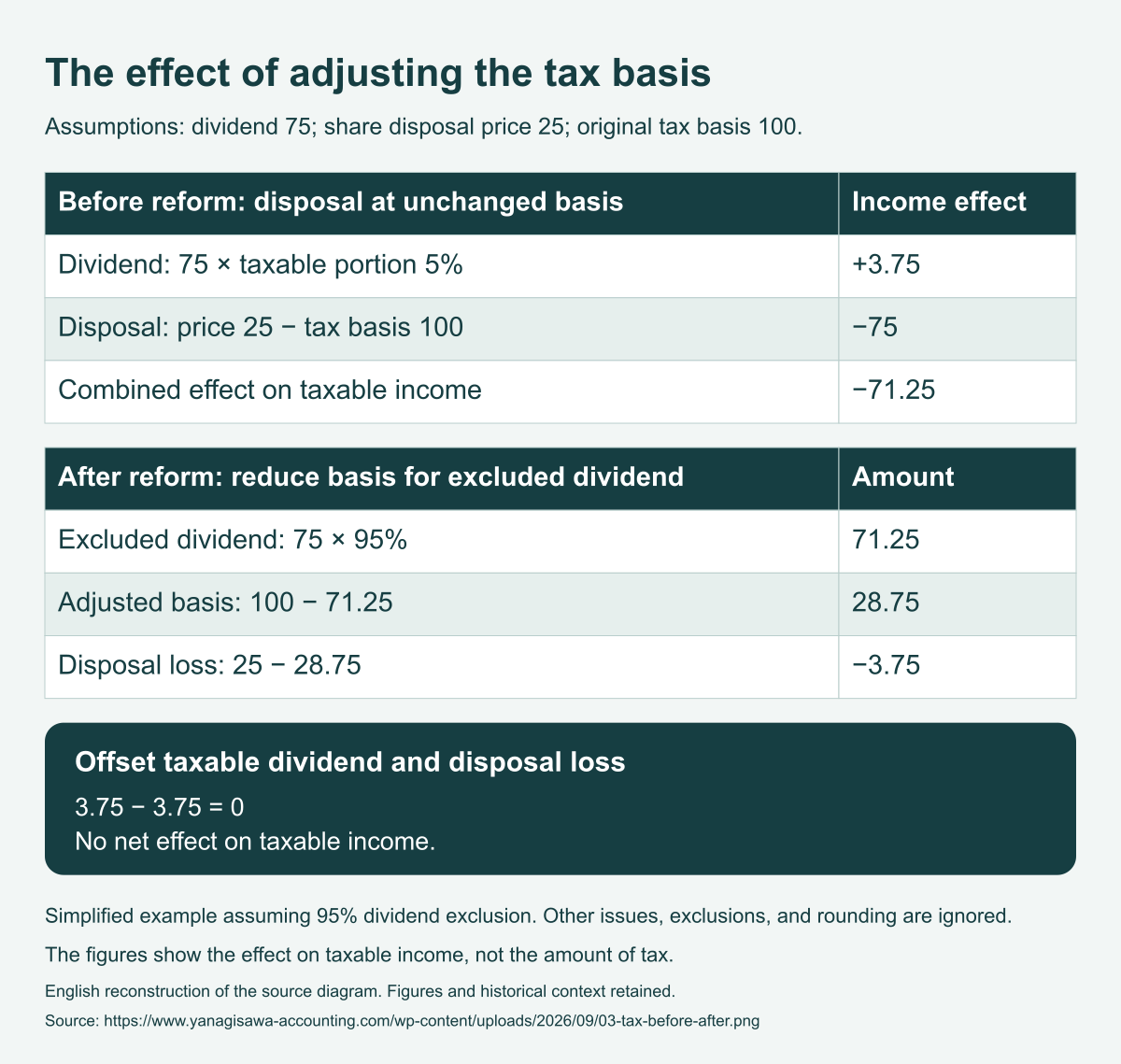
| Item | Without Basis Reduction | With the Basis Reduction Rule |
|---|---|---|
| Taxable Dividend Portion | +3.75 | +3.75 |
| Post-Dividend Share Tax Basis | 100 | 28.75 |
| Share Disposal Loss | −75 | −3.75 |
| Total Income Effect | −71.25 | 0 |
The reduction here is the excluded amount of 71.25, not the full dividend of 75. Given the 95% exclusion assumption, including the taxable 5% provides a more accurate understanding of the regime's effect.
At introduction, the rule applied fromdividends received in fiscal years beginning on or after April 1, 2020. Saying all dividends dated on or after April 1, 2020 are covered omits the fiscal-year condition. It also does not mean the new regime applied retroactively to the 2018 transaction. Ministry of Finance: Government Tax Commission Materials of November 4, 2022, Page 68
10. Does Every Dividend Require a Basis Reduction?
The regime has scope and exclusion conditions. A typical starting condition is acontrol relationship exceeding 50%through the parent and related parties, with the covered dividend and prescribed dividends in the same fiscal year totalingmore than 10% of the shares' tax basis. Government Tax Commission Materials, Page 68
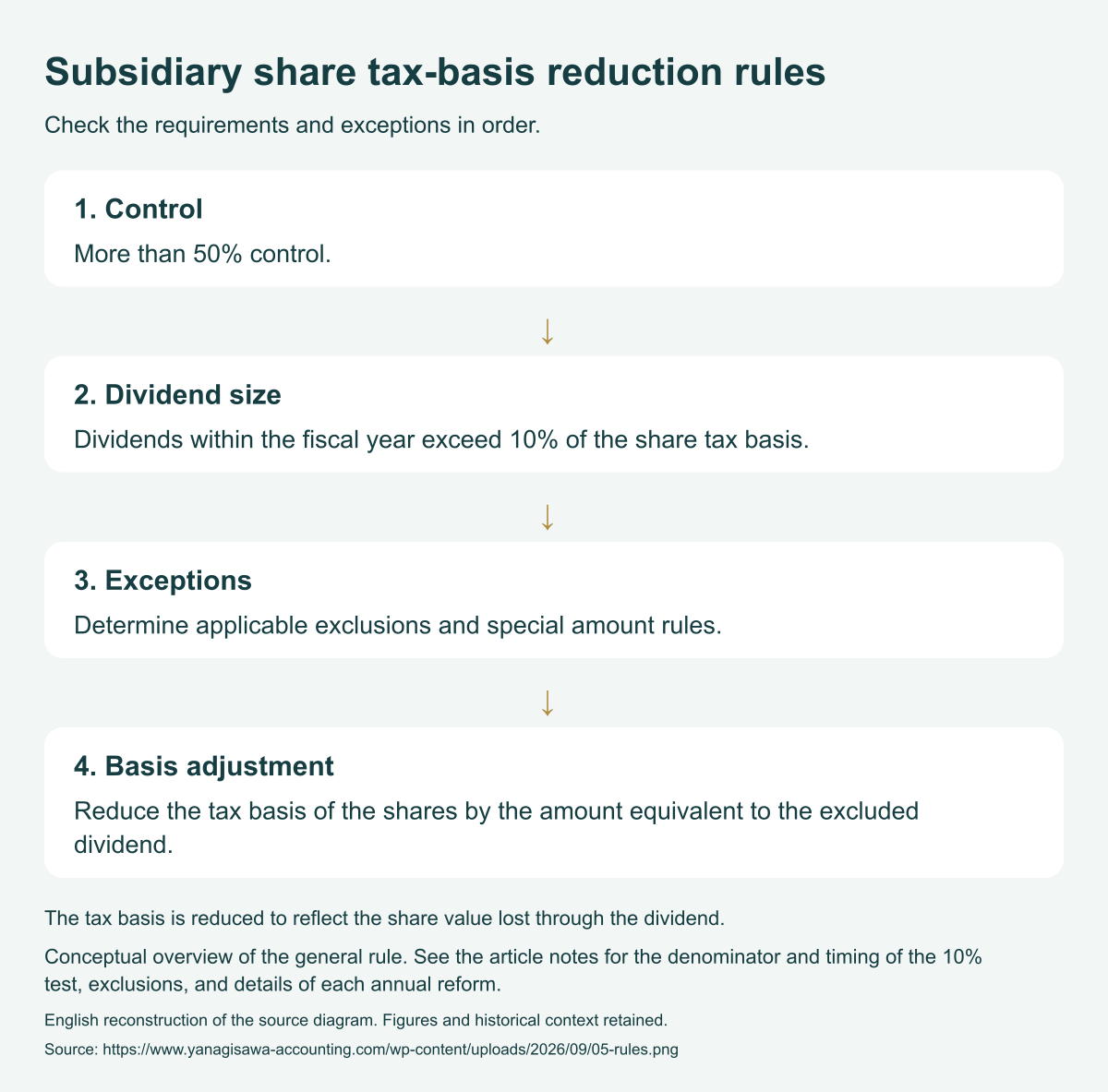
Treating the 10% test denominator simply as opening tax basis is inaccurate. The National Tax Agency uses the largest share basis immediately before the reference times of the relevant dividends. Because dividends within the same fiscal year are aggregated, merely splitting dividends does not avoid the test. National Tax Agency: Commentary at Introduction
Four Exclusions
The exclusions established at introduction have the following basic structure.
| Exclusion | Purpose and Main Tests |
|---|---|
| Domestic Shareholder Ratio Requirement | For a dividend-paying domestic ordinary corporation, check domestic shareholder ownership of at least 90% and other conditions from incorporation to the specified control date |
| Retained Earnings Requirement at the Specified Control Date | Use the prescribed comparison to determine whether retained earnings from before control was acquired remain after the dividend |
| Long-Term Control Requirement | Exclude dividends more than ten years after the specified control date |
| Small Dividend Requirement | Exclude cases where the covered dividend and prescribed dividends in the same fiscal year total JPY 20 million or less |
These are Ministry of Finance: FY2022 Tax Reform Commentary, Pre-Amendment Regime, Pages 635–639 provides details. Domestic shareholders include prescribed domestic corporations and residents, and some tests require record retention. The table summarizes the purpose of the rules.
This does not establish that all dividends from domestic subsidiaries are excluded. The regime is not limited to foreign subsidiaries and must also be considered in domestic M&A. Long-term control requires checking the period's starting date as well.
Exclusions Differ from Special Amount Rules
Separate from exclusion from the regime altogether, a mechanism limits the amount deducted from share basis. These special amount rules take account of portions corresponding to distributions from profits accumulated after control was acquired.
Policy distinguishes extracting value accumulated before acquisition from distributing profits newly earned through post-acquisition business activity. Treating both identically could unduly restrict ordinary profit distributions.
However, simply stating that profits arose after acquisition is insufficient. Determine which dates' retained earnings apply, how dividends and reorganizations are adjusted, and whether required schedules and documents exist. The dividend source must be explained numerically under the regime's formulas.
11. FY2022 Reform: Reflect Profits Earned During the Year
The FY2022 amendment allows retained earnings tests to reflect certain in-year increases and interim dividends, subject to conditions. Looking only at the preceding financial year-end may fail to reflect profits actually earned afterward. National Tax Agency: 2022 Tax Reform Commentary
For example, suppose opening retained earnings are 100, subsequent profit is 30, and a dividend of 20 is paid. Deducting 20 only from the previous year-end's 100 gives 80, while including the in-year increase gives 110. This matters in determining whether pre-acquisition accumulated profits were extracted.
This is an illustrative example, not a reproduction of the statutory calculation. Actual calculations separate profits and dividends before and after the specified control date and require adjustments and record retention.
The amendment also adjusted anti-avoidance provisions for certain multilayer corporate relationships, considering control from incorporation and other factors. The 2022 changes apply to dividends received in fiscal years beginning on or after April 1, 2020. Describing them generally as applying only to dividends from 2022 onward is incorrect. Ministry of Finance: FY2022 Tax Reform Commentary, Pages 639–649
12. FY2024 Reform: Acquisitions and Dividends in the Same Fiscal Year
The FY2024 amendment concernscases where the specified control date and subsequent dividend receipt date fall within the same subsidiary fiscal yearunder the special amount rules.
The previous calculation compared retained earnings at fiscal year-ends before the dividend and before acquisition of control, limiting cases with acquisition and dividend in the same fiscal year. Building on the FY2022 mechanism for measuring in-year retained earnings, the FY2024 amendment makes the special amount rules available in these same-year cases. Ministry of Finance: FY2024 Tax Reform Commentary, Pages 753–755
The following illustrates the situation.
| Events Within the Subsidiary's Fiscal Year | Matters to verify |
|---|---|
| Acquire the Company and Obtain Control During the Year | Identify Retained Earnings Before Control Was Acquired |
| Business Profits Arise After Acquisition | Identify Profits Accumulated After Control Was Acquired |
| Pay a Dividend to the Parent Within the Same Year | Reflect the Post-Acquisition Profit Portion in the Special Amount Calculation |
This does not exclude every same-year dividend. The underlying dividend and share basis adjustment regime remains, while the scope for appropriately treating post-acquisition profits expands.
Application begins withcorporation tax on income of domestic corporations for fiscal years beginning on or after April 1, 2024. Separately check the subsidiary's same-fiscal-year test and the first applicable fiscal year of the domestic parent.
13. A Single Timeline from Transaction to Legislative Reform
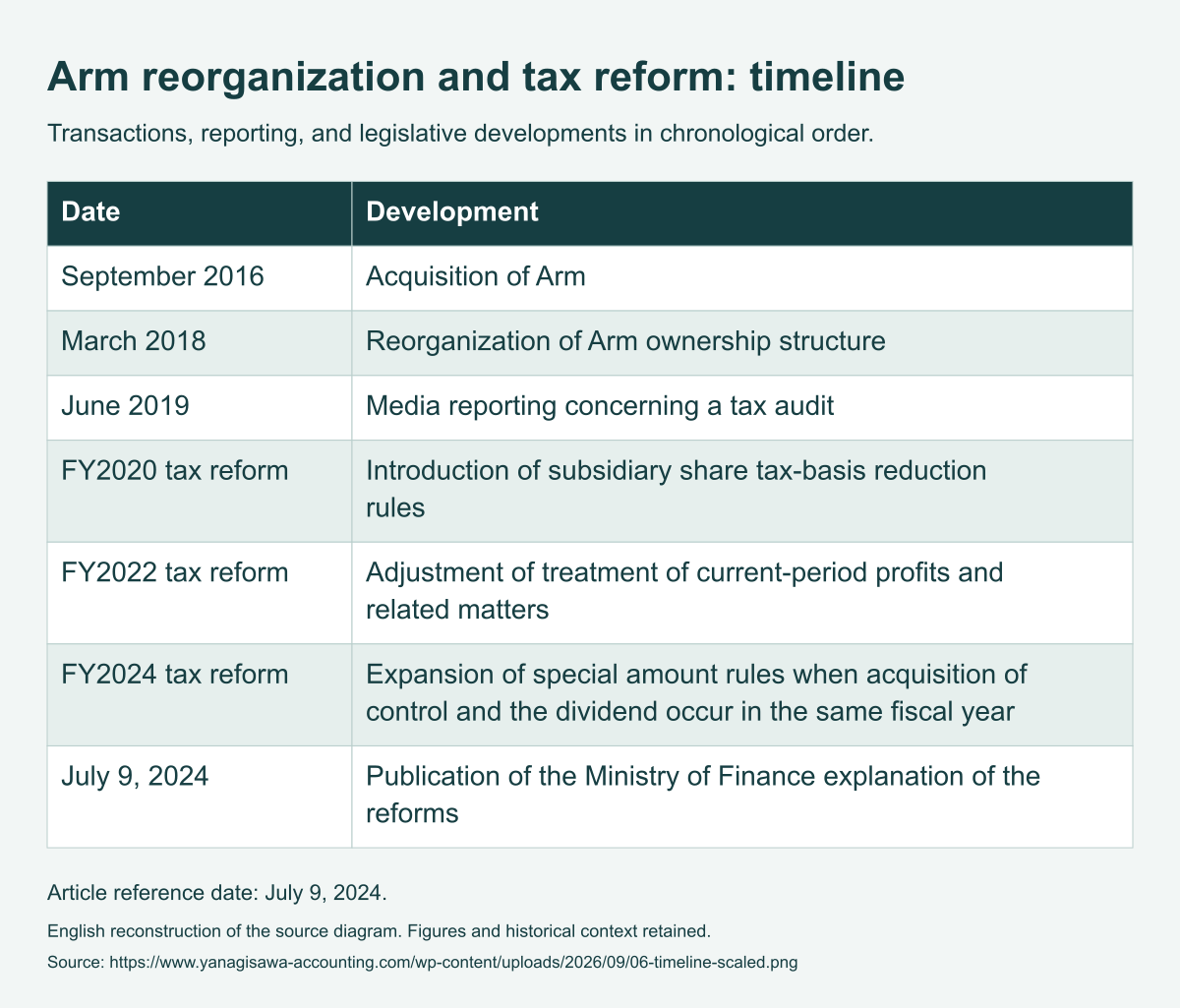
The sequence has three stages: the transaction effects created by combining individual provisions; the legislative response linking dividend investment recovery to share tax basis; and refinements to avoid excessive adjustment of profits genuinely earned after acquiring control.
Government introductory explanations and Tax Commission materials identify this type of transaction as an issue without naming SBG. Meanwhile, 2020 expert commentary notes reports that SBG's transaction prompted the reform. Published analysis linking a transaction to reform is not the same as an official government statement that the regime targeted one company.
Nor does introducing a regime amount to a judgment establishing illegality of past transactions. Distinguish the transaction year, applicable provisions, and relevant facts.
14. Lessons for M&A Practice
This case shows that acquisition price alone does not reveal the overall tax burden. Post-acquisition dividends, changes in subsidiary tiers, and transfers of shares to other entities or funds connect different provisions.
In practice, first map ownership and transaction sequence. Then separately track tax basis at acquisition, accounting carrying value, and market value at each transaction for the same shares. For a dividend, check not just its amount but retained earnings before and after it and their relationship to the control acquisition date.
The current basis reduction rule cannot be assessed solely by whether an immediate share sale is planned. Certain dividend receipts trigger basis adjustments that affect future disposal gains or losses. Model the eventual exit when deciding on the dividend.
| Review Sequence | Specific Matters to Organize |
|---|---|
| Identify the Transactions | Dividend Payer, Share Issuer, Share Transferor, and Receiving Entity or Fund |
| Fix the Relevant Dates | Acquisition, Establishment of Control, Dividend Resolution and Receipt, Share Transfer, and Each Entity's Fiscal Year |
| Separate the Amounts | Transaction Price, Market Value, Accounting Carrying Value, Tax Basis, Excluded Dividend Amount, and Tax Disposal Gain or Loss |
| Assess Exclusions and Special Rules | Domestic Shareholder Ratio, Control Period, Cumulative Dividends, Retained Earnings Movements, and Required Documents |
| Estimate the Tax Impact | Offset Against Income, Loss Utilization Restrictions, Tax Rates, Timing of Use, and Foreign Taxation |
Isolated explanations that dividends are exempt or share transfers create losses do not establish restructuring tax treatment. Connect the transactions and identify when and in what form value was recovered. The Arm restructuring and subsequent amendments demonstrate why this is necessary.
Reference materials
Links in the text point to supporting passages. The main sources are listed below.
| Source | Role and Main References |
|---|---|
| SBG: Completion of Arm Acquisition, September 5, 2016 | Company Announcement of Target, Ownership Acquired, and Consideration |
| SBG: 2018 Shareholder Meeting Online Disclosures | PDF Pages 58, 60, and 61: Dividend in Kind, Contribution in Kind, and Accounting Treatment |
| SBG: 2019 Shareholder Meeting Notice | Printed Page 56: SBG Separate Income Statement |
| Mori Hamada & Matsumoto: April 2020 Tax Reform Commentary | Page 2: Expert Analysis of the Tax Structure of the Reported Arm Restructuring |
| Shigeki Morinobu: Reflections on SoftBank Group's Tax Avoidance, November 15, 2019 | Page 1: Explanation of the Dividend in Kind and Share Transfer Based on Reports |
| National Tax Agency: Foreign Subsidiary Dividend Exclusion Q&A, July 5, 2010 | Questions 1 and 2: 95% Exclusion and Basic Ownership and Holding Period Requirements |
| National Tax Agency: Commentary at Introduction in 2020 | Purpose, Basis Reduction, and Dividend Size Test |
| National Tax Agency: 2022 Tax Reform Commentary | Treatment of In-Year Retained Earnings |
| Ministry of Finance: FY2022 Tax Reform Commentary | Pages 635–649: Previous Regime, Exclusions, 2022 Revisions, and Application |
| Government Tax Commission: November 4, 2022 Materials | Page 68: Covered Transaction Types and Outline of Countermeasures |
| Ministry of Finance: FY2024 Tax Reform Commentary | Pages 753–755: Special Amount Rules for Control Acquisition and Dividends Within the Same Fiscal Year |
| Ministry of Finance: July 2024 Updates | Confirms Publication of the Reform Commentary on July 9, 2024 |
All diagrams were created for this article. They do not fully reproduce actual ownership structures. Application depends on transaction dates, fiscal years, and individual facts.
This general explanation is based on materials published by July 9, 2024. Application depends on individual facts; please consult us before implementing a transaction.
If You Would Like Advice on Your Own Circumstances
We provide tax advice suited to your circumstances, including returns, inheritance, and company taxation.
Japanese Tax ConsultationsSee consultation topics, fees, and how to book.